Pages

Showing posts with label Kyouto. Show all posts

Tuesday, 15 September 2015

Nintendou has a new captain

Kimishima Tatsumi (君島達己)
Earlier this summer, the president of Nintendou fucking died. His name was Iwata Satoru, and while he wasn't necessarily the most beloved figure in the industry it certainly came as a shock. In the wake of this tragedy, Nintendou took the opportunity to reshuffle its upper-level management while considering his successor. Yesterdayish, the company released a statement naming Kimishima Tatsumi as the new head of the company.

Additionally, Miyamoto Shigeru has been the recipient of the newly created title of “Creative Fellow.” Head of Nintendo Entertainment Analysis and Development (formerly R&D1), ie the section of the company that actually makes the games, Miyamoto is responsible for Mario, Zelda, and other masterpieces. The new title seems to indicate more a recognition of his contributions to Nintendou than any change in his role within it. (Some fans expressed a desire for him to become president, which makes no sense. Miyamoto will never be president. Even if his creative skills were transferrable to the financial side of the company, if he became president he'd obviously no longer be making games.) Takeda Genyo, meanwhile, is now a Technology Fellow, seemingly the hardware equivalent to Miyamoto's software stuff. “Fellow” is a bit of a weird-ass ingredient to throw into a salad full of words like “Representative Director,” but oddly enough it kind of fits with Nintendou's style.

That said, Kimishima's appointment is the far more interesting and important part of the announcement. Beginning his career in banking, he joined The Pokemon Company in 2000. (Not to be confused with Game Freak, the development studio that actually makes most of the Pokemon games, The Pokemon Company is mainly concerned with marketing and licensing the franchise.) He then joined Nintendo of America for several years before coming back to Japan, where he was responsibly for various businessy aspects of Nintendou, like Human Resources and the always nebulous “General Affairs.” Clearly the experience and the skillset is there; the question now is how he will stack up to Iwata.

Iwata Satoru (岩田聡)
On the one hand, Iwata clearly had a deep and abiding love of games, believed in his company, and at one point appeared willing to take the fall for lacklustre WiiU sales. He took steps to make himself appear relatable and accessible to his company's fandom, such as through Nintendo Direct, where he “directly” addressed fans (customers) regarding current products and issues. On the other hand, this also gave some the impression that he was weak and simpering, and while “Please Understand” was a stupid, lazy meme, it did represent many people's dissatisfaction with the direction Nintendou was taking. Meanwhile, Iwata presided over one of the weakest periods in the company's history, financially and artistically. If you want to be charitable you can acknowledge that he was facing varied challenges the best way he knew how, and that shouldering the entire blame on one person is absurd, but you can't deny his responsibility for the disappointment.

In contrast to Iwata's attitude, I see one particular sentiment floating around the Internet regarding Kimishima: “He's a businessman, not a gamer.” There's a few things to unpack there. First of all, there's no doubt that Iwata was a gamer, but in the sense that he lead a huge business, how exactly was he not a businessman? I guess the answer would be that he was not a skilled businessman, or that his attitude towards the business was insufficiently businesslike. Except, the implication seems to be that having a gamer leading a games company is good and would naturally lead to high-quality products, while a businessman will bring us soulles cash-ins.

Sure, having a passion for your industry and its products can potentially be a tremendous asset. One way to put it is that as the head of a games company, you are in a position to create the kind of games that you would want to play. Individual tastes and all that, but you can be reasonably sure that a certain proportion of consumers will nod right along with you, and that whatever you make, it will at least have artistic conviction. You may also be better equipped to read the currents of popular feeling; how often have we heard the complaint about company executives being out of touch?

However, I am of the opinion that business acumen is also extremely valuable to have when conducting business. It's also wrong to say that a lack of personal interest necessarily equates to a lack of understanding. Suppose I got hired at P&G tomorrow. As it stands, I do not feel any deep emotion for household cleaning products, but if it were my job to know about them, you can bet that for the next few weeks I would be spending every waking moment learning. I would learn exactly which chemical compounds are most effective at scouring stains from carpet and the thought process that goes into Mrs MacMillan's purchasing decisions when she's at the grocery store. Naturally, games, which are art rather than science, are that much more dependent on instinct, but it's not like market analysis has never steered anybody into a bad business decision, anyway.


Personally, I'm intrigued. I never got as down on Nintendou as a lot of people did, because Mario and Zelda are just so much fun. Still, I feel as though shaking things up like this could really reinvigorate the company. Surely the gravity of his position is not lost on Kimishima. In Shadowrun, Nintendou would be an A-ranked corporation at least, and it is no small fixture of Japanese culture both at home and internationally. Hopefully we get at least a few good games out of it.

Tuesday, 22 April 2014

Introduction to Japanese Philosophy, Part 2: People and Concepts

In the last post, I outlined the historical and cultural/religious factors that influence the Japanese understanding of Philosophy. And it took way longer than I thought it would, so I ended up having to break it up into another post. Which is fine. Thinking up stuff to write about is hard sometimes. Messes up my posting schedule.

As I noted before, most of the big names in Japanese philosophy are Buddhist thinkers. Here's a few of them and a couple of abiding concepts.

The 17-Article Constitution

Shoutoku Daishi
Way, way back in the day, Japan was ruled by the young 聖徳大師 Shoutoku Daishi or, as he is called in English, Prince Shotoku. He was responsible for the drafting and promulgation of Japan's first constitution, except the thing is, it is entirely unlike what you or I would envision. Rather than a system of rights and regulations, Shoutoku Daishi's constitution had more to do with what was considered acceptable and virtuous behaviour. To some extent it was a little biased towards court officials, who were expected to lead by example; this kind of follows the ancient Chinese thinking that if the Emperor is good, his underlings will emulate him and be good, and so on, so that ultimately all of society is good. Trickle-down morality, basically.

Here are some of the highlights:

  • Harmony is to be valued
  • Sincerely revere the Buddha, his teaching, and the ordained community
  • Turn away from that which is private, and turn toward that which is public
  • Important decisions should not be made by one person alone.

So there's Buddhism, right there, written into the ancient Japanese constitution. You are literally required by law to be a good Buddhist. The first and third, meanwhile, would not seem out of place in modern Japan! Let's not exaggerate, but it's not unfair to say that Japanese people strive for harmony and facilitation in their everyday lives. And finally, that last one – one person should not have absolute power? That's an interesting thing for an autocratic dictator to write into official policy.

Interestingly, since it was never actually struck down by any act of parliament, some Japanese legal scholars theorize that the 17-Article Constitution is technically still part of Japanese law.

Kuukai

Kuukai
Also known posthumously as 弘法大師 Koubou-daishi, 空海 Kuukai was an explorer of tantric Buddhism and of the most prominent religious figures in Japan. A poet of some note, he is credited, perhaps apocryphally, with writing the いろは歌 Irohauta, which uses every character of the ancient Japanese syllabary exactly once. It's one of the most famous works in all of Japanese literature and is sometimes thought to embody the very spirit of Japan itself (that's “spirit” as in a shared sense of values, purpose, and culture, not like a religious spirit). Also, if I recall correctly (and I may not), Kuukai was the first Buddhist of influence to assert that women could reach Heaven without needing to first be reborn as men and then taking another crack at it. Also, his name is a combination of the character for “air” and the one for “sea,” so that's pretty cool.

Nenbutsu

Yoshimitsu from Soul Calibre
In brief, 念仏 nenbutsu is the Japanese word for invoking the name of Buddha. If you have a passing familiarity with Japanese popular culture, you'll have heard the most basic version before – namu amida butsu. For example, Yoshimitsu from Soul Calibre sometimes recites it after battle. The idea is that invoking Buddha himself brings you closer to the enlightenment he was able to achieve. The nenbutsu is often done in repetitions of 108, which is the number of worldly temptations that humans must attempt to avoid (or seek out, depending on your point of view). To help with counting, Buddhists will sometimes use a string of prayer beads, which, again, you've no doubt seen people holding – hell, some of the pictures on this very page have them plainly visible. But while the basics of nenbutsu are more or less agreed upon, there is still some contention, such as that between...

Hounen and Shinran

Hounen
放念 Hounen and 親鸞 Shinrann are kind of the Obi-Wan and Anakin of Japanese philosophy. The latter studied dutifully under the tutelage of the former, soaked up every bit of knowledge he could, and then said “thanks for that, Imma go do the exact opposite nao,” and then founded an evil empire. Or in the case of Shinran, a competing sect of Buddhism, which I guess isn't quite as bad.

The two had many minor points of contention, but one of the most important was their differing beliefs regarding salvation. Hounen thought that through dutiful nenbutsu recitation, you could effectively reach out to Buddha and rise up to Heaven of your own accord when you died. Shinran was a little less optimistic. He thought that since humans are so utterly mired in sin and confusion, there was no way they were getting anywhere without Buddha's direct intervention. Concordantly, where Hounen advocated busting out the nenbutsu at the slightest provocation, the better to achieve a more thorough enlightenment, Shinran held that it was more for giving thanks to Buddha rather than asking him for more stuff, sort of like saying grace in Christianity, I suppose.

On the whole, I've always felt that Hounen doesn't get nearly the respect he deserves. Shinran is by far the more famous, but Hounen is pretty interesting too, and his temple is pretty rad. Plus, compared to his pupil, he was a rugged individualist who believed in relying on your own power, so where are your stereotypes now, hypothetical Japan-hater who I invented just now?

Dougen

Dougen
I haven't studied 道元 Dougen as much, so I'm less familiar with him (because that's how studying works). Mainly I'm aware that he was pretty up on 座禅 zazen, which is – know what, just go ahead and imagine a Buddhist deep in prayer. There, you almost certainly envisioned him doing zazen, the sitting meditation with legs crossed. For extra potency, you can have his thumbs and forefingers around his abdominal chakra. My History of Japanese Thought teacher demonstrated on himself. “I know it feels stupid,” he said, “but don't be embarrassed, and give it a try.” No one did.

Kyouto School

Full disclosure: I did not talk about the Kyouto School in my original presentation and took most of the information in this next section from Wikipedia, although I had heard of it before, it just completely slipped my mind until I rediscovered it recently while researching something unrelated to this project.

I thought it was interesting for a couple of reasons, one of which is that it originated in the 20th Century, balancing out the ancient slant present in the rest of the post. I'm not a huge fan of 20th Century philosophy – it has, what? John Rawls? Ayn Rand? Vandanna Shiva, if you can call that philosophy? A couple of French guys, Camus I guess, and (that guy Bruce translated). And a handful of Germans, of course, but Germans are just extremely dominant in philosophy in general, owing, perhaps, to their having the best educational system in the world in the 19th Century.

Fittingly, the Kyouto School is heavily influenced by the German tradition, particularly their own German contemporaries. This is pretty natural, though – once you hit the 19th Century or so, the Germans become pretty heavy hitters in philosophy. In fact, my teacher actually went to Germany to study philosophy – in German. (And some of my friends told me not to worry because I could speak German if I wanted to, even though I don't speak German, but do speak Japanese, and they all should have known that, particularly as they were explaining all of this in Japanese and we'd never spoken anything else to each other before then either, but that's another story.)

The other reason I thought them particularly relevant is that the Wikipedia article contained a couple of quotations specifically on the relationship between Japanese philosophy and religion, which, as I've intimated elsewhere, is something I've grappled with myself in trying to understand the topic. I'd feel a little chintzy directly quoting something I'd heard about before but never properly researched, so I'll just recommend you follow the link if you're interested, which, if you've read this far, you probably are. Pay special attention to Nishida, who founded the tradition, and explored the concepts of mu, “nothingness,” and 場所論 bashoronn, “the logic of place.”

The Ten Bulls

Finally, we've come to the main thing I wanted to talk about, and the focus of my presentation at the conference: The Ten Bulls! I'm actually not sure I like the translation, because there's ten images, but only one bull, and he doesn't even appear in all ten panels. The Japanese is 十牛図 juugyuuzu, more like “ten bull pictures,” but anyway, it's an allegory of the search for knowledge, the truth, inner peace and understanding, something along those lines. It actually originates from the Chinese equivalent of Zen Buddhism, but is studied enough in Japan that I'm willing to consider it Japanese philosophy as well. So we're going to go through, step by step, and see what we can figure out.

#1, the boy – or man or whatever he is – is alone in the forest, searching. But he has no idea where to go, or what to do, so he wanders aimlessly, lost.

#2, he comes upon some footprints – a path to follow. He hasn't found what he's looking for just yet, but now he's moving in the right direction. This could be in the influence of Buddha, or a Bodhisattva, trying to help us out. It actually reminds me of that little place near the front of Kiyomizudera, where you descend into a pitch-black basement, and have to follow a railing so you don't crash into anything, and the railing is supposed to represent Buddha's guidance.

#3, he spies the bull's back legs and hindquarters. The bull seems to represent “wisdom,” or whatever you want to call it. But he hasn't caught sight of the important part of it yet – just the tip of it, the ancillary, irrelevant parts.

#4, he manages to actually catch the bull. But it doesn't immediately relax under his grip, it struggles for control. This is significant – at times, the things we most want seem to actively reject us.

#5, the boy has gotten to a point where he can take the bull around on a lead. He no longer needs to exert quite so much discipline to get it to do what he wants.

#6, now he's attained REAL mastery! He's riding on the bull's back, he's playing the flute while he does it, he barely even needs to pay attention to what he's doing. He rides it all the way home.

#7, sitting at home now, alone. The boy seems to have aged, matured. More importantly, the bull is gone – the target was an illusion. He doesn't need it anymore.

#8, this one sometimes moves around, but I'm going by the most common order. My philosophy teacher, in Kyouto, said that this was the most most important image of all. When he explained it to the class he said, “As you can see, this one is blank. Why do you suppose that is? There must be some meaning hidden in that. …Think about it, it's going to be on the final exam,” and then he moved on, without any further explanation whatsoever.

As far as I can tell – through reading various secondary sources – this panel is meant to imply a sort of transcendence. The boy has moved beyond the trivialities with which he was so concerned until now. Another interpretation is peace and tranquility, as the mind has been allowed to fade to white. Personally, I am reminded of Wittgenstein (fucking Wittgenstein), who believed that words, by themselves, were insufficient for understanding ideas. They could cajole you into understanding, drive you down the right avenues of thought, but they could not, by themselves, transmit knowledge. So you could use them as a sort of crutch, a ladder, but one which, as he said, you would then have to “throw away after you have climbed up,” because they're just tools, not the object of the exercise themselves.

#9, both boy and bull are still gone, nothing but the sound of cicadas chirping. Again, tranquility perhaps? Or signaling that he is now attending to more important matters?

#10, the boy has become a sage or Bodhisattva, and is now using what he has learned in his experiences to educate others.

Obviously, the intent behind this series is very Buddhist. That would make it of very limited interest, but it doesn't have to be that way – actually, you can take this and apply it to almost anything you want to learn! Hell, I could use my own experience learning Japanese as an example.

  1. I knew that I wanted to “learn Japanese,” but I certainly had no idea where to start, or how to go about it.
  2. Fortunately, I had many excellent teachers to show me the way. They provided learning outcomes as well as relevant materials, helped me with difficult concepts, etc.
  3. Naturally, I started simple. Everything written out in roumaji and exceedingly simple. I was not, at this point, actually communicating in Japanese in any meaningful way, but it was a start.
  4. Try as I might, I couldn't actually get to a point where I could use Japanese fluidly or for any length of time. Frustrated, I actually considered giving up a couple of times.
  5. Once I'd mastered the basics, I started to show measurable improvement. Further progress became a little easier. Eventually, I even started having bursts where I could use Japanese without first translating in my head (without even noticing when it happened until later).
  6. Finally I actually came to be able to use it with some degree of fluency, to make it do the tricks I demanded of it. (In the analogy I would now be “done learning,” though in reality of course you are never done learning a language.)
  7. The goal was never to make it all the way through the textbook, or to get a certain score on a test; the goal was to learn Japanese. I don't need those things so much anymore, so I abandon them. (Though if I ever find another textbook that works for my current level, I'm obviously not going to pass it up.)
  8. While I still actively strive to improve my Japanese, I've gotten to the point now where I can just use it.
  9. Cicadas. I admit I don't really get how this one works.
  10. Nowadays, I am capable not only of teaching Japanese to others if I wanted to, but of helping them through the same steps and struggles that I have already overcome.

See that? Ok, it's certainly not perfect, but for the most part it works. Philosophy isn't just this academic, impractical discipline; if it were I'd never have become wrapped up in it. It honestly doesn't provide any answers, either, because for every assertion there's a million objections, and nine different philosophers will give you nine contradictory proposals. But the fun parts of philosophy are finding applications for it in your everyday life. Apply the categorical imperative to your coworker's bad behaviour. Do a Marxist analysis of the other tabs you have open right now. See if you can prove your own existence. That sort of stuff.


As long as Japanese philosophy gives me things to think about, I'll keep it in my mental notebook.

Monday, 18 November 2013

Finding Diagon Alley

There's a Subway restaurant on one of the short little pedestrian streets that cut back and forth between Kawaramachi and Shinkyougoku. I visited so often the staff learned my order. Japanese Subway isn't quite as good as Canadian, I'm sorry to say, but it's still hard to beat a delicious hot sandwich. Plus, it was located directly across from a Rainbow Karaoke, where we went the night I met Seven and Hyeong, so while I ate I liked to amuse myself by watching the incredibly obnoxious promo video loop constantly.
It's just one of a dozen or so places I took to frequenting in the downtown core area. By the time my year of study abroad was coming to a close, I knew the place pretty well. The broad strokes, at least. Here's a place to buy beer. Here's a place to eat cheaply. Here's a place where you can buy books, and for some reason also clothing. I had a good understanding of where all the little oft-ignored shrines were tucked away. I knew where the karaoke places and the convenience stores were (at intervals of every ten and two steps, respectively).

This is why it was such a start to glance down a gap between two buildings and realise – whoa, there's a couple of people walking around back there. Where are they...? Wait wait, there's more of them! Are they – is there a bunch of cool stuff back there?

As soon as I stepped through – it was really like a doorway – I realised what I'd stumbled upon. There was a whole goddamned town back here! A whole network of thoroughfares and switchbacks, wide enough to drive a car through! Not that you'd want to; you'd forever be getting stuck behind slow walkers. It was a decidedly pedestrian affair, couples, families, old dudes, young girls, everybody just going about their business. I found out that Round1 has a parking lot behind it. OPA has a whole other storefront I never knew about, and it's every bit as ostentatious as the one on the street. There were cafes, a small bar, funky expensive clothing stores, and what might have been a lawyer's office. Or possibly a yakuza branch office; it's hard to tell at a glance in Japan.

As I wound my way around, I realised that I'd seen some of this stuff before, passing between the aforementioned streets. But it had never occurred to me to look any farther; like a hopeless Muggle, I'd been totally unaware of the Diagon Alley that was just out of sight, teeming with life and interest, if you only knew where it was. And really, it's utterly amazing that I never discovered it earlier. Perhaps some of you are reading this and marveling at my density, because you found it on your very first sweep through downtown. But I was amazed that even after a year and a half, Kyouto could still be hiding some secrets right in my territory.


It's one of the (many) reasons I love cities, actually. I'm an extrovert in the truest sense of the word, drawing energy from the people around me, so the more of them there are, the happier I am. Sobriety and mental elbow room be damned! Give me a crowd. Nature and serenity? Get some concrete and glass in there! Likewise, you can talk to me all day about familiarity and sometimes wanting to go where everybody knows your name, but I'd rather have dynamism. A city is like a lover – so complex and so deep, you could know them for a lifetime and still have more to learn.

Wednesday, 18 September 2013

A touch of typhoon

Rude Boy: You and I haven't had a class together since like spring 2011.
President: Wow. Sounds like a bad omen.
Rude Boy: Mm?
President: Spring 2011...?
Rude Boy: Oh. Shit. Well...I'll just withdraw if it looks like anything bad's about to happen.

I guess I'd better get on that.

If you're not aware, a typhoon hit large parts of Kyouto, Shiga, Hyougo, Ayamane, and also apparently Toukyo, though much less directly. Kyouto and Shiga seem to have been the worst-hit, being inundated with powerful rains and flooding. I sort of shrugged it off at first – typhoon, big deal. It happens. But then I was cruising Facebook and I saw this picture:

Yeah, I flagrantly ganked this from a stranger's FB feed. Sue me. Actually no, don't.
If you live in Kyouto, you should recognize this spot. Or maybe not; it took me a good ten seconds. That's Sanjou Oohashi in the background, Sanjo Keihan Eki further in the background, and, directly in front of us, a pedestrian footbridge. It's one of the most popular meetup and hangout spots in the city, and I was pulling through there once a week at bare minimum.

It's difficult to describe, now, what I felt in the moment I saw that photo, and over the following day. Of course at that time I was a little more uncertain of the situation. Last I read, only eight people have died, several of them rather elderly, and the news reporting all seemed to focus on evacuation efforts and property damage rather than loss of human life. But without being there, I had no way of knowing what things were actually like on the ground. I couldn't read the mood, and know whether Kyoutoites were bonding and powering through or despondent over the destruction. Most of all, I felt like I should be there. Not even that I should be doing something to help, just like I should be in the thick of with everybody. I didn't have any information, I couldn't do anything to help, maybe there wasn't even anything to do, and I felt thoroughly cut down to size.

I thought: Can forces of nature stop destroying my adopted homeland now.

And also: Please God, don't let this be a day that we remember for years.

Because I still recall with great clarity exactly what I was doing when I found out about the Touhoku Earthquake. Hell, I remember every detail that came for the next month, because of everything we were all doing. I didn't want this time to be like that. Let it wash away like so much water, a non-lethal non-event.

Of course I feel a little silly saying this now, knowing as I do that everything was pretty much ok. Udon is fine. Shiga is fine, English Club people are fine. But there was about a 48-hour period there where I was checking in and nobody was responding, which, rationality aside (they're busy, they might not have power, some people suck at texting), had me concerned.

It's weird that this typhoon could be even a fraction as affecting as Touhoku was, despite being a grain of sand in comparison to a beach, just because it's a place that I know well, and have developed a certain affection for (even though I still maintain that Kyouto is kind of shitty). I wondered if this is what it feels like to live in New York, and be watching a movie, and have it depicting scenes in places you could walk to from where you're currently sitting watching the movie. Actually, you probably get used to it.


So I tried to imagine my Canadian hometown undergoing a similar crisis. Try as I might, I couldn't make it real. Because these things could never happen to you, right?

Saturday, 14 September 2013

Lonesome Road

As soon as Udon sees me off, I'm alone. From here on out, it's all strangers and solitude. I'm riding to Umeda, but instead of the excitement I would normally feel at a day or night of fun ahead, I just feel drained. Fuck it. Here we go. I really am leaving Japan. Well. Fuck.

I get hung up at Umeda because I fail to realise that I need to make my transfer at Oosaka, and spend over an hour wandering around like an idiot, but it's so hot and I am so goddamn tired, I just kind of go with it. Important point is, at no time do I feel nervous. Concerned, yes, but it's all purely intellectual. I've grown.

I'm riding the express but do not realise that there's an additional cost associated with this until a guy comes around to check my ticket. He addresses me in Japanese and does not bat an eye when I speak it back to him, I pay the difference and he gives me a ticket, and I slump back against the wall, not at all embarrassed about having made a mistake. The train pauses for a while for seemingly no reason; the old ladies near me speculate that it's either regular maintenance or a suicide. One of the two. I reach my station and disembark. I have to say, it has been my experience that carting luggage around the major transit centres is no big thing, but as you wind away into the local stations it becomes increasingly burdensome, in this case requiring a series of confused elevator rides just to reach the opposite platform.

Easily locating my hotel, I have a lengthy and detailed conversation with the guy at the front, and not once does he remark on the unprecedented multitasking of my speaking Japanese while being foreign. I appreciate the compliments, I really do – but from time to time it's nice to have my ability to communicate in the language of the country I live in not be pointed out like it's a fucking UFO sighting. I head to 7-11 to print off my electronic ticket, which seems to contradict the whole “electronic” idea, but I accomplish the deed while barely paying attention. I am so in control.

It's late and the train ride took hours. But I've arrived! At least now I can relax. Well, I've misplaced my fucking cell phone charger, but nothing I can do for the moment. Fortunately, Jugs is online, so my final sad, lonely evening doesn't devolve into a totally self-congratulatory emo wankfest. But then...

[5:56:13 AM] Rude Boy: OH WOULD YOU FUCK RIGHT OFF. the documents i printed at 7-11 i now cant fucking find
[5:56:46 AM] Rude Boy: WHAT
[5:56:47 AM] Rude Boy: THE FUCK
[5:57:57 AM] Jugs: :c
[5:58:29 AM] Rude Boy: im leaving japan
[5:58:34 AM] Rude Boy: im leaving a lot of things
[5:58:47 AM] Jugs: bb, i can' even imagine how hard this is for you
[5:58:53 AM] Rude Boy: i am so. incredibly. fucking. tired.
[5:59:07 AM] Jugs: but i can promise you lots of hugs in canada
[5:59:27 AM] Rude Boy: it is SO MOTHERUFCKING HOT JUST FUCK RIGHT THE FUCK OFF THREE MONTHS LAREADY SERIOUSLY FUCK. OFF. JUST FUCK. OFF. no more plz. no more of this fucking heat. i am so fucking tired
[5:59:46 AM] Rude Boy: i cant even
[5:59:48 AM] Rude Boy: i cant do this.
[5:59:57 AM] Rude Boy: i am actually just
[6:00:02 AM] Rude Boy: WHJERE THE FUCK ARE MY DOCUMENTs
[6:00:47 AM] Jugs: you totally can do this
[6:01:18 AM] Rude Boy: i actually am almost breaking down right now
[6:01:33 AM] Jugs: you not being able to do it isn't even an option in anyway
[6:02:05 AM] Rude Boy: it is so fucking hot
[6:02:07 AM] Rude Boy: where are my documents?
[6:02:11 AM] Rude Boy: where?
[6:02:13 AM] Rude Boy: where? :(
[6:02:17 AM] Rude Boy: where are my fucking documents? :(

So far I've concealed my emotions, but that one little thing has made me snap. Thankfully, Jugs is an awesome person and stays online to talk me through it even though it's already morning in Canada. And I do eventually find the fucking things, thank fuck. Unfortunately, I can't reply to the message that Udon has almost certainly sent. I feel pretty bad about that.

In the morning, I catch the shuttle to Kankuu. From this point forward, the idea that I might speak anything other than English does not occur to anyone for the rest of my life. At Immigration, an old man punches a hole through my gaijin card, but then he gives it back, an unexpected souvenir.

I'm staring down the barrel of 25 hours of continuous travel; a duo of pointlessly long stopovers have conspired to try and make me kill myself. More than anything else right now, I wish for a companion. Not even to help me work out my complicated transfers and baggage dickings-around; it's cool, I will do all of the thinking, I will make all of the decisions. I will be the grizzled world traveller. It's only that it's going to be fucking boring. I want someone to bullshit with. Seriously, I'll take almost anybody. I'd even take a particularly calm and astute child at this point. Well, maybe not Insufferable Dumbass. I'd leave him at home. It defeats the purpose to bring someone who will make the trip feel even longer.

At Incheon, I find that I'm actually remembering many of the areas I passed through the first time around. Is this what it's like to be a capable, experienced international plane person? I'm sorely tempted by the “Experience Korea” souvenirs, but decide that it's a little tacky to buy something from an airport gift shop without ever having actually seen the country. Maybe if Korea still sparkled...
An Indian guy about to begin studying in Canada gets cornered by one of the dumbest people I have ever heard words slough out of. He asks how long he's lived in Korea (five hours), and why he didn't go visit the ocean if he had so much time between flights (are you...really?). He then inquires as to why he didn't just take a flight directly from Mumbai to Vancouver, all at once demonstrating that he knows absolutely nothing about international travel, or geography, or humanity, or the laws of physics. I try to bury myself in the book that I started reading at YVR a year ago – The Sun Also Rises, turns out it's pretty great – but his exuberance bores itself straight into my brain. Oh hey! Looks like I did bring Insufferable Dumbass with me! I am finally saved when he convinces the Indian guy to go line up for the plane shortly after it arrives at the airport. Eventually I follow in their wake. Some guy has tried to take my window seat. Haha, no.

I watch Iron Man 3. It's bad.

Setting right my mistake of nearly a year ago, I order the bibimbap. The flight attendant asks if I've ever “tried” it before, which seems a little condescending, but how is she to know that I'm not a moron. Good luck I didn't pick JAL. I'd Kansai-ben their ears off and then we'd ALL feel awkward. Still though, you take everything they give you and mix it together, it's not fucking hard. The meal is quite tasty. In my experience, Asian food survives the transition to “airplane food” most intact out of any cuisine.

I watch a Chinese movie called “Finding Mr. Right.” It's surprisingly good! It's about a young Chinese woman who goes to America to have her sugar daddy's baby so that the government doesn't force her to abort it, but then she meets people there and plot ensues. You should watch it. Also the main girl is gorgeous.

All the Korean movies are action movies and supernatural thrillers. Why can't I just watch a silly romanticomedy? I want to learn “You had me at hello,” not “Make him an offer he can't refuse.” The only Japanese movie heavily involves dogs, so that's out, too. Luckily I'm tired. My strategy was to stay awake as long as possible in order to sleep as deeply as possible, because I know that once I fully wake I'll pretty much stay that way. Time to make out with the cabin!

I stir from my slumber and crack the window. Still dark outside the plane. The moon is reflected against the wing, and I crane my neck to peer up at it. This high in the atmosphere, there's little between us but space. Crazy.

When I wake again, the people beside me are eating breakfast. A small sign has been attached to the seat in front of me: “While you were resting, we were unable to serve you. Please let our service staff know your preference.” It earns points for saying “resting” rather than sleeping, but then immediately loses them all by making it sound like I'm causing problems for them. How about “It is our policy not to disturb passengers while they are resting. Our staff would be happy to serve you at your convenience.” See, I could totally be in marketing. A guy comes by and asks me for my choice, with an attitude suggesting that his job would be so much easier if it weren't for all these fucking people trying to fly to places. His pronunciation is frankly terrible and the only option I understand is “omelette” so I take that even though I know it will be an abomination. I can't finish it.

Then I'm in Canada again, somehow. White people everywhere. Negotiating yet another labyrinth of signage, and then Immigration – I don't like the bullpen style of YVR. Kansai and Incheon are a little clearer and more streamlined. They've installed a new “electronic border guard” system since I was last here. Did you guys know about this? You scan your passport and then your paperwork, greatly speeding up the process and, presumably, lowering the airport's overhead (no pun intended). An automated female voice even warns me that border services will have some questions for me.

A young, blonde woman frowns at my customs paperwork and, not unkindly, asks, “You have unaccompanied baggage with you?”

Well, no, ma'am. If I had it with me, it would be accompanied baggage.

Anyway, I end up getting a customs receipt so that I won't have to pay tax at the post office (as what I'm importing is within my exemption), so it turns out that it pays not to lie to the government. Very, very occasionally.


At Tim Horton's, I fumble with the coins, barely recognizing them.

Friday, 6 September 2013

Final 10 seconds

I feel low. Empty. In a few short hours I will leave the dorm, and this time tomorrow I'll be on a plane. I wonder if this is what a person feels on the morning of their execution: Resolute in my hopelessness, resigned to the fact that one way or another, it's all over now. I've done everything I can. I've spent a year of my life, incurred massive debt, and I'll probably never know for certain if there was any meaning or value to any of it.

I've seen things you people wouldn't believe. Chinese hookers off the streets of Koube. I watched drunk gyaaru glittering in the morning light near Kiyamachi. All those moments will be lost in time, like tears in rain. Time to die.

I never got to see Udon. We were going to meet one more time, but she got called into work at the last minute. I was crushed. Can't be helped though. We'll see where we're both at next time I'm in town. Whenever that is...

Jesus, it's been a whole year already? Christ, it's only been a year?

I wonder what they'll say about me, when I get back. I barely recognize the person I was when I got here. I've always felt I was a confident person, and a patient one, but that's only gotten stronger. I've gained new skills, of course, and – well, I hope my Japanese has improved, anyway. My curiosity has in no way lessened, but I no longer feel anxious when I don't understand every little detail. I've gotten better at asking for help.

There's nothing left now. I slowly finish the last of my packing. Begin to tidy mine and Cologne's room, taking my time about it. I am so very sad. I--

Holy shit a message from Udon.

“Well, I'm free this afternoon (lol)”

Holy shit holy shit holy shit holy shit holy shit.

I kick into high gear. Oh god. Room check, we have to get ready for it right fucking now. Udon confirms that she is available until 4. It's goddamn 1:30. Ok. Ok ok ok. Toss that shit right the fuck into the suitcase. Shove it in good. It's all crumpled and fucked up! Never mind. Vacuum. Jesus Christ fuck cocks gotta run up and down the fucking hallways and oh god damn it there are no vacuum bags have to run to the first floor and borrow their vacuum. Vacuum vacuum vacuum when did our room get so many corners. Cologne woke up obviously and now he's showering, please oh god oh please for once in your life don't take an eternity in there. Ok ok shove the rest of my clothes in. Um, backpack! Electronics! Ok hopefully that's everything. What if it's not?? Fuck it. Gotta take a chance every once in a while. Can't live your life cloistered in your fucking library. Check all the drawers oh fuck right off I forgot some stuff oh fuck it don't even look just throw the whole pile into the garbage. Oh good he's out of the bathroom ok vacuum the bathroom ok is that good enough? Yeah I'm saying that's good enough. Ask to do my room check two hours early; luck out and get the go-ahead. Dormitory lady pronounces room is spotless. Please god faster. Need to surrender keycard and room keys. It is so fucking hot out and I'm so tired my hands are shaking so bad I can't even slip the key off the ring oh fucking finally there we go.

And...we're done?

I skitter back upstairs. Mother Russia isn't in; I will probably never see her again. Goodbye Lithuania! Goodbye French! Goodbye Tiny Korean Girl! Goodbye Korean guy! Goodbye Cologne! Goodbye assistants! Oh fuck that's right – I hurriedly entrust a bag of coffee, one final parting gift for Mother Russia, to one of the assistants. A few people, startled and confused by my leaving ahead of schedule, rush downstairs to see me off, wondering what could have precipitated my haste.

“Take care of Mother Russia,” I request of the dorm staff.

And I'm off and running down the driveway, suitcase rumbling ridiculously in my wake.

I'd envisioned this moment a hundred times, but it never looked like this. Sometimes it included one pensive, final walkabout of the dormitory; perhaps a ceremonial final usage of the keycard that had made so many midnight 7-11 runs possible; and most definitely an overly long, possibly wailed set of goodbyes. Not so here. In a way, it's actually better. I'm afforded a clean break. At the train station, the tears claw at my throat and beg to be released. I ignore them.

I've rushed like fucking nobody's business. And at 3:20, I finally meet up with Udon.

I'm exhausted and incoherent and I look like shit but she doesn't even mind. We sit in Starbucks and we talk until 4:30, when she finally admits that she really does have to get to work. Of course I wish we could have spent more time together, but it's just about the perfect length of time for a goodbye. We have a lot of fun. We have a fairly frank conversation about what might happen between us when I come back to Japan, and although a million things can happen in even six months (the absolute minimum time I'll be away), we leave the door open.

I do realise that I'm kind of fixating on a girl that I've only actually met three times, but there is something there. There is definitely something there. If we'd met in, say, March, I'm positive we'd be dating by now. But then, even such a short time ago, I was a completely different person, so – although I don't believe in any conspiracy of God or “the Universe” meddling in human relationships – in a way perhaps it had to happen now.


As we're walking to Hankyuu Kawaramachi so she can see me off, I realise that she is the last person I'll see this year. How fitting, I remark. She laughs. It's really just about the best sendoff I could have hoped for.

Monday, 19 August 2013

Fushimi Inari

Increasingly as of late, every time I see a picture of some famous Kyouto sight I find myself thinking "Oh hey, I've been there." Across four visits in twelve years, one way or another I've ended up going to pretty much every single major tourist destination in the city. In fact, Fushimi Inari was basically the last one I had left. With my time here rapidly running out - for the moment - this was to be a sort of swan song for my solo Japan travels, one last box to check off the big list.
I was almost immediately waylaid by a blonde English girl, who was looking for a different station. I helped her find her destination and in the fifteen minutes or so that we spent together, I learned that she was teaching English in Viet Nam, and had come here for a visa run. She was quite interesting; I'd have liked to talk with her more. I'm always fascinated to talk to expats from different countries, especially other Asian countries.

Anyway!
 Hey, does this remind you of anything?

Ordinarily I would have shot this whole area much more extensively, but on this day, the camera angle, subject, and composition was often determined by factors such as where the shade happened to lie, and whether or not I had been standing in direct sunlight for more than zero seconds.
 Foxes! Foxes everywhere! They're messengers, apparently. This one has a key in her mouth.


 Ok, so now we're heading to the main event...
 A ton of gates! Seriously. For some reason I'd been thinking there'd be just one line of them, somewhere. No way. We're talking tens of thousands. There's a mirror on the grounds and blah blah blah, but this is the main event here at this shrine. It also appears at the end of Memoirs of a Geisha, which, though I hate to admit it, is kind of what made me want to come here in the first place.


 What.

 See, I told you they were everywhere.
 A branch in the path! Whatever. I didn't know the meaning of either character (both of which recur, together, throughout the complex) off the top of my head, so I just chose one at random. I went with the right one. Judging by the video above, the left is the one where Memoirs was filmed. Damn!
 So if you look down the path, the gates appear to form one solid wall, but if you view them at an angle, you can see the gaps. Now if you're like me, you've wondered just how far apart they actually are. Here's a picture, with my hand for scale. Answer is: It's completely inconsistent. Some are jammed up right against each other, some I could almost squeeze my body between. I hope that was informative for you.
 Couples! Couples everywhere.

 Like I say...it turned out to be a much larger place than I'd anticipated. Come here expecting to invest some time, bring good walking footwear, and prepare for a lot of uphill walking. And don't be afraid to head back down once you've had your fill, because you're never going to explore all the various paths unless you work here.
 Just behind the main shrine area. Wow. Ok. We get it, Fushimi Inari. You like gates.
 After following behind this agriculture fan and his gf for a bit, I decided to explore a side path. After twenty minutes of walking, I was rewarded with fascinating sights such as this:
 Well, ok, also this:
 But, again, also this:

 Also, this. This is either a Shintou god I'm not familiar with or the most ostentatious Buddha I've ever seen. I actually stood there and wished I'd had Stupid Ugly Foreigner with me.
 Couple!

 This is where things got truly arduous. I stopped even bothering to try to take photos. There was nothing but stairs. And gates, which at least provided ample shade, but mostly, stairs. Stairs and stairs and stairs and stairs and stairs. At one point I had to rest because I felt the onset of delirium. But I didn't gave up. And my tenacity was rewarded with...!
 This thing. Yay?
Ok, also this.

Sunday, 18 August 2013

Nijoujou

One day I'm going to do a full post detailing the Shinsengumi. In fact, I already have one mostly written, sitting deep in the bowels of my "blog" folder. But today, although we're going to be visiting the group's iconic headquarters, we're going to glaze over a bit of the history and the details. If you're unfamiliar, it's enough to know, for the time being, that they were a small group of elite samurai who acted as a sort of special police for the Tokugawa bakufu, and like modern police, they sometimes clashed with other divisions, such as the rival Mimawarigumi. They were subject to a strict and somewhat arbitrary code of conduct, the penalty for violating which was being commanded to commit suicide. They wore intimdatingly colourful haori into battle, per the above photo (though they probably actually wore yellow, not blue), and were organized into eleven squads, each led by a talented soldier with all manner of stories surrounding him. They were basically the late-Edo Gotei 13tai, and wow do I hate myself for even typing that.
 And they operated out of this place.
 Easy access! Only one gate is open to the public at the moment. I know, because I started by taking a stroll around the whole complex. It took a solid 20 minutes.
 The moat isn't particularly deep and certainly not impassably wide, but you can imagine how stressful it would be to try to lurch across and then scale the walls while the defenders constantly fired rifles and bows at you.
 K, so here we are inside. Nijoujou is full of flat, open spaces.
 My plan was to arrive as early in the morning as possible, in order to avoid the crowds and thus get better shots. As you can see, my plan was a rousing success.
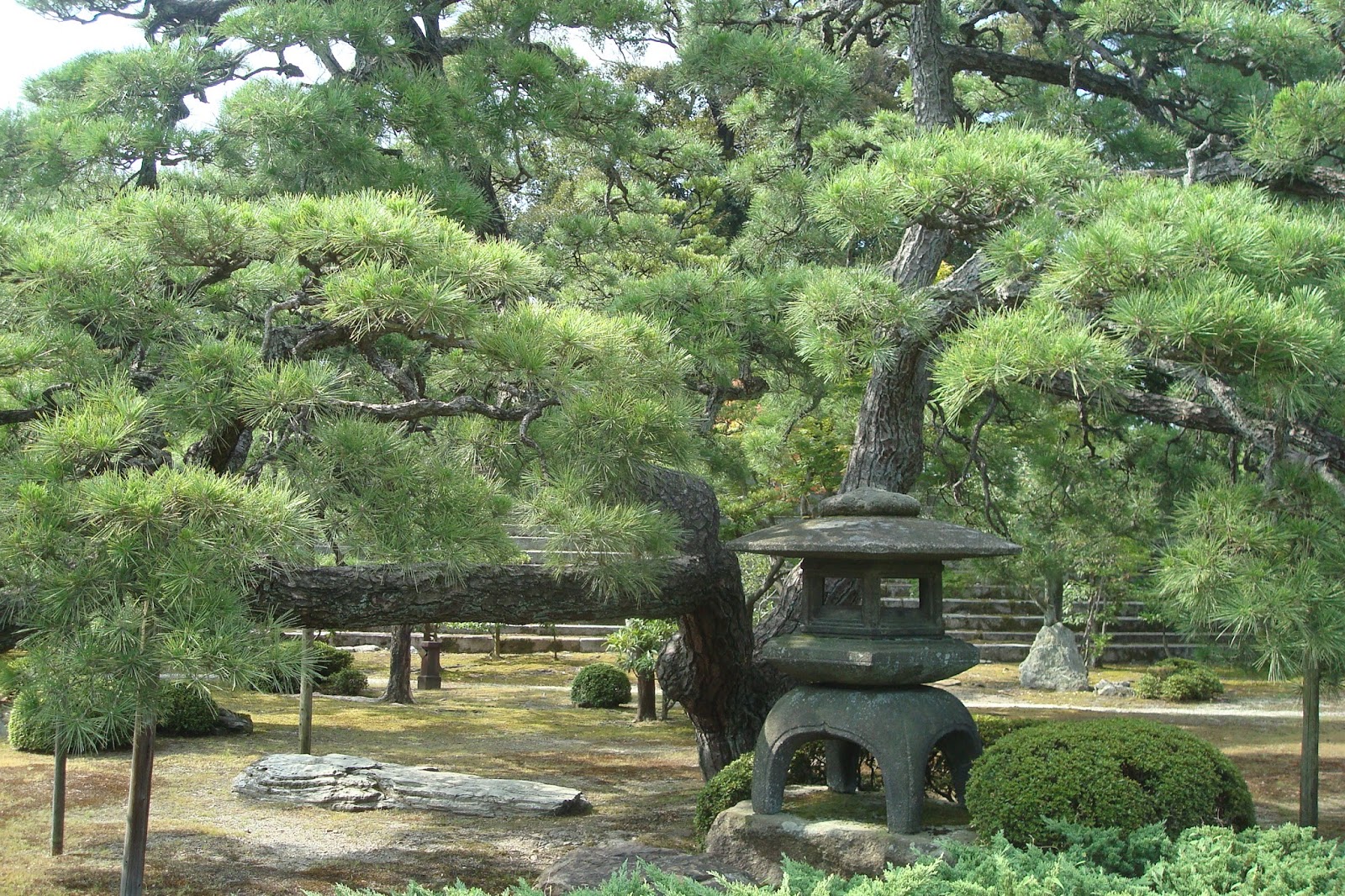
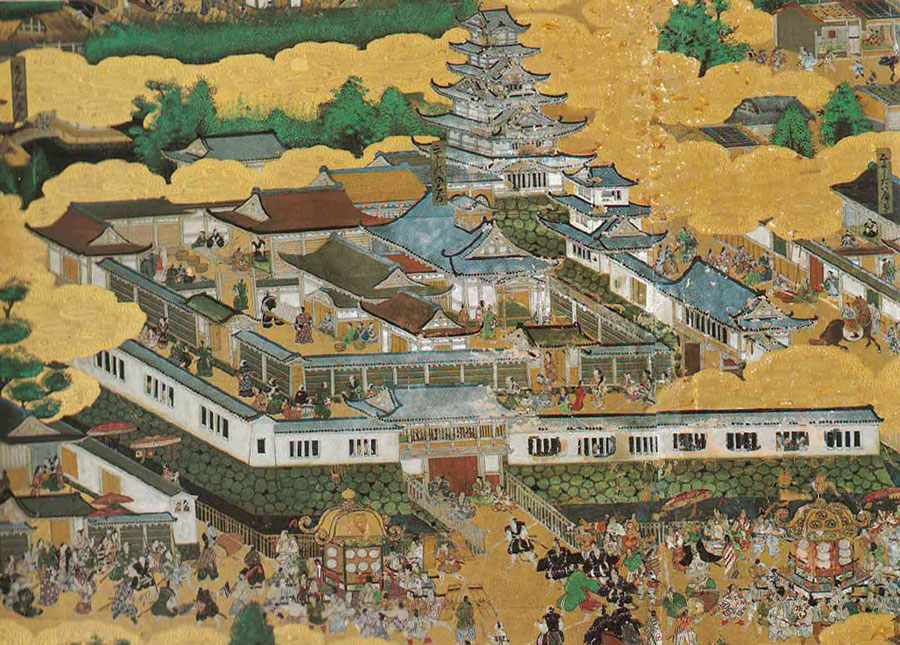
 You can only go into some of the buildings, and only at some times of year, and only if you pay extra money. I didn't really try to understand it. The site was used for different things at different times, including the Tokugawa residence, a young noble's household, and the Imperial Cabinet, and of course parts of it have been destroyed and rebuilt over the centuries, so functionally speaking it's a bit of a patchwork.
 Should that be "so" keep off? A bit demanding if that's the case, but I can't think what else it could be. Hmph.
 Bells, but I couldn't read the explanation. I'm sorry.
 The first area opens into a beautiful garden...
 ...which, naturally, you are not allowed to walk through. Still though.

 A second moat protects the inner, more important section, the actual "castle" part of the castle.

 You've gotta be kidding me, there's a whole garden type thing up here too?! Wow. Nijoujou is just overflowing with green.

 I don't even really like nature, and even I'm beginning to think that I'd enjoy living here. I mean, not by myself, obviously. Maybe me and some of my close friends, and a few tenants, a retinue of bodyguards, and staff. Yeah, that could be really nice.

 Let's head up these stairs...
 ...but not before whirling and taking a shot of this couple. ^0^

 I thought I'd be able to look out and see some of the Kyouto cityscape, but I was wrong. Instead, the trees block our view, lending a feeling of insulation. I also thought a refreshing breeze would blow off the moat and cool me off, but I was wrong. Instead, it was still hot as balls.
 So cool.
 Glancing back.


 As we make our way back to the entrance we're directed to another, smaller garden. This one has what appears to be the warden's residence. In reality there's probably like a ride 'em mower or something in there.
 Conspicuously regular trees.
 Ostentatious!
 Some of the buildings are suspiciously modern.
 I was curious about this, but not enough to both pay an additional 100 yen and take my shoes off. One or the other, ok; the two in combination, can't be bothered. Probably wasn't anything too too spectacular anyway. What, now you're curious too? Oh, fine.
Source.
Probably a bunch of stuff like this, if I had to guess. Ok, that is kind of cool.
 Classy.
There are better castles, and 600 yen entrance is a little steep, but Nijoujou is a nice visit. Also, while researching this post I found a video that you might enjoy, so let's finish out with that: