Pages

Showing posts with label manga. Show all posts

Tuesday, 31 March 2015

Canyon

During my high school exchange, I saw some people online talking about the first Iron Man movie, which had recently been released. And my first thought was, “Iron Man? I don't even remember seeing trailers for – oh, right.”

Similarly, in a once-recent post by Stupid Ugly Foreigner, he laments the disconnect from English-language popular culture he suffers while living in China. This phenomenon is exemplified in Pharrell's “Happy,” of which he was utterly unware until long after it had already become entrenched in our cultural constitution. Now that I'm back in Canada, I'm facing kind of the opposite problem, and when I get back I'm going to have to relearn everything.

An example: The first time I heard Kyari Pyamu Pyamu's seminal "Pon Pon Pon," it had already been popular for months. In fact it's almost strange to me now to think that there ever was a time when I'd never heard it – it's so clearly ingrained in the cultural landscape of its era. To not know at least that much was to have no idea what a certain type of Japanese person was listening to at the time, and that shit was important to me. I leaped aboard that particular ship as soon as I saw it, and then throughout the rest of the year I managed to catch everything new as it bubbled up into the cultural consciousness of Japanese young people. Unfortunately I've now effectively lost all knowledge of what's trending back there, and it's going to take time to get back up to speed.

I can use the Internet to keep abreast of the latest vicissitudes in television and idol gossip, but that's a poor substitute for everday immersion because it's all through my own filter - limited, not "off the street," not necessarily bearing any relation to what's actually popular. Metroid, for example, is more popular outside Japan than within it. In the Korean's account of his tour of the South by Southwest music show in Austin, I read that he saw a relatively new Japanese loli group called Starmarie, who were supposedly the most popular Japanese singers going. Except that my immediate reaction was “Who the hell are Starmarie?” Sure enough, it turns out that they are indeed a popular Japanese idol group – in America.

So what, you may say. It's just movies and music and other meaningless bullshit. You might have a point. A mild de-syncing with cultural developments that will no longer be relevant a year from now might seem like a fairly minor loss. But remember that anime and music and dramas and everything else are all things I have a certain dependency on, because they're my primary means of studying the language. I am constantly on the hunt for new material to consume, integrating its knowledge into my biomass, mining it for not only new vocabulary and grammar but cultural tidbits and talking points. Without the constant, effortless exposure you get in Japan, I am forced to subsist on what I can scavenge from YouTube or d-Addicts.

Access to this stuff also affects my studying habits. I've always been a proponent of self-motivation – that is, if you really want to learn another language, you just do it, every day, or else adjust your expectations. That means that on a day when you come home from work or school, exhausted, depressed, and without the slightest desire to study, you clench your teeth and do it anyway. So it'd be idiotic to say that lack of access to Japanese pop culture adversely affects my study regimen, but easy access to it does positively affect it. You should always be able to force yourself to study, but a spoonful of heroin makes the medicine go down.

Also, though I have no pedagogical training, I feel like all the studying I do while in this “engaged” state is more effective. Perhaps I am simply more receptive at such times, and thus better able to absorb new vocabulary and constructions. Or perhaps even more simply, I just pay closer attention when I'm interested. Or maybe it's just my imagination. Anyway I'm not going to stop.

Finally, a big part of a country's contemporary cultural identity either stems from or is resolved in its media trends. I don't think that's too grandiose a statement. The plot twists in big TV shows get people talking. Artists use their media to communicate a deeper message. People will resort to the refrain of “relax, it's just a movie” for as long as movies continue to be made, but that's utterly and obviously wrong. Our art, even our for-profit art, is both informed by our shared cultural experience, and adds to it. It's important. It's not World War II-level historical significance, but you can't just discount it.

And again, for me, soft culture is a part of how I connect with Japanese people - knowledge of what's trending in their pop music and television is often a good ice-breaker. And how many friendships are born from mutual interests? The early conversation of practically any first encounter is spent searching out common ground. Obviously don't hinge your identities on what anime you like, because if you want to be interesting you have to be interesting in and of yourself. But I can't count the number of times I've inspired shock and delight for merely having heard of something Japanese. If nothing else it shows that you're receptive.


On the other hand, I guess if not being quite up on the latest moves and grooves is my greatest concern, as compared to somebody arriving with no knowledge of Japan or Japanese, maybe I'm doing all right. There'll be a brief period of adjustment, but in no time I'll be slinging timely observations and relevant pop culture references like anybody else. Now all I have to do is find a job, win the lottery, or earn the favour of the yakuza, and I'll be good to go.

Sunday, 26 January 2014

Philosophy of Fullmetal Alchemist, Part 3


Appendix: Japanese interpretations

Before starting this series I googled “philosophy of fullmetal alchemist,” but I didn't come up with much, so my previous two parts in this series may very well comrpise the fullest philosophical treatment of this series in English. However, there's a lot more material available in Japanese. After writing the main body of this post – to keep my interpretation original – I gave 「鋼の錬金術師 哲学」a try. Here's some of the top results.


Kira Alicetear says that she (?) feels an affinity for the military characters, specifically those in Mustang's crew. “I particularly like that the Flame Alchemist is cold on the outside but burns with passion on the inside, and I like Hughes too, but that might just be because I've always had a thing for men of action.” She's not sure how she feels about Hawkeye because, except for her romance plotline, there's little connecting her to the main story. “Oh, and I like Scar and Izumi too.”

“But I think the real reason I came to like Fullmetal Alchemist...was its world.” She explains the principles of touka koukan, using, as I do, the example of a chemical equation. She makes the additional point that for a chemical reaction to occur, some kind of energy is required, speculating that it may come from living organisms. When watching the anime, she thought that the concept was similar to something she'd heard of before, but only remembered when she went to read the tankoubon.

“It was similar to the essence of the Study of Logical Philosophy.” Oh for fuck's sake, now she's talking about Wittgenstein. I guess that means I was onto something when I was ranting about him earlier, but on the other hand, Wittgenstein. Go away, Wittgenstein, go away. “Although I've never actually read Wittgenstein's book 'Tractatus Logico-Philosophicus.'” You're better off, sweetheart. Next part's hard to translate – I think it says that in Wittgenstein, the interaction of language and the world form the figurative “map?” And that the one-to-one correspondence of language and events is similar to the system of alchemy. Another example:

“Language (the internal structure of a proposition) → (Wittgenstein's logical method) → the World (the internal structure of events)”

“The first example [of the chemical equation] and the second example can have a (logical) one-to-one correspondence, and Wittgenstein's logical method corresponds to military drilling. Thus you can conclude that alchemy exists currently (logical philosophy), and that so do alchemists (Wittgenstein). Lol.”

“In Wittgenstein's logical method, you can say that the world and language are of equal value. If you put this to practical use, it means that if the internal structure of the world changes, the internal structure of language changes along with it.” Sure. If language exists to describe the world, then naturally it must change to suit the times. “However, if the internal structure of language changes, the internal structure of the world that it indicates changes with it as well.” I can dig that, too. As far as I can tell language both drives and reflects culture. However, Kira seems to say that the relationship is not quite the same, because in Wittgenstein, “'there is only one interaction between the real world and language,' that is, an equivalent value that goes in only one direction.”

Having said all this, Kira still believes that we can “smash” Wittgenstein's philosophy. “That is to say, there exists a society that can only be seen as a glimpsed fantasy of 'if the internal structure of language changes, the internal structure of the world changes.' It's Japan. A society that satisfies this theory existed 1000 years before Wittgenstein. The so-called 'belief in the soul of language,' and societies with taboos, are certainly fantasies, at the very least it is thought that songs and words have influenced Japanese culture.” OK, you grabbed my attention with the bold, no-frills declaration of “it's Japan,” but are you going to at least justify how this is specific to Japan and not just world cultures in general? “I've strayed from my main point.” I guess not.

“Touka koukan is not the only resemblance between the world of Hagaren and the logic of Wittgen.” Now she explains the taboo of human resurrection and its impossibility. This is because of the law of touka koukan, which prevented the brothers' mother from actually returning to the world of the living in spite of their successfully creating a human body. “In the logic of the world (Truth) that cannot be reached simply through the one-to-one correspondence of language and the world, the frustration of these two alchemists (Ed and Wittgenstein) is very similar.” I think I know what she's referencing. Wittgenstein believes that words are insufficient means for describing/understanding the world, saying that once you have understood something you must discard the linguistic steps you took to get there or as he puts it “[he] must so to speak throw away the ladder after he has climbed up on it.”

She also mentions that some of Wittgenstein's ideas seem to be contradicted by Goedel's incompleteness theorem, “though it was written in Goedel's book that Wittgenstein actually misunderstood the incompleteness theorem,” but that this allowed Wittgenstein to move closer to his “language game” concept – much as Ed and Al were able to use their mistake to move closer to the Door of Truth.


The first respondent identifies the theme of karmic retribution, represented in the rules of touka koukan. There is a conflict between absolute rules and morality, and the morals of the main characters usually win out. Kimblee seems to be a mouthpiece for Arakawa. He preaches that humanity should own up to its failings and not avert its eyes from the dirty things it has done. In his last moments, Kimblee allows the brothers to succeed. You could look at this as either opportunism, or an interesting conclusion. However, she seems not to have put any hidden meaning in Hagaren, and it is probably just as it appears (though I, Rude Boy, hasten to note that this is different from there being no meaning).

The second respondent finds it interesting that all attempts at human resurrection fail without exception. This view of death must have been something Arakawa wanted to get across. Also, “zen to ichi” seems to have been inspired from the ideas of the ancient Hellenistic societies.


“Alchemy comes up often in discussions of the history of engineering.” I would not have guessed that. “The worldview of alchemy explains the achievements of classical mechanics and Newton.” Wait, people study the history of engineering? “The 'touka koukan' idea from Hagane no Renkinjutsushi explains the viewpoint of engineers.”

“Like, the 'touka koukan' idea from Hagane no Renkinjutsushi, you know?
“Basically touka koukan = you have to have something of equal value to exchange, you know?
“To obtain, something of equal value must be lost, you know? < Anime.
“People cannot obtain anything without first giving something up, you know? < manga. That is, 'logic = the path that people must protect.' It's wonderful!”

“I wonder if Philsophy is required material for Engineering?”

“Philosophy and Biology are kind of the same, aren't they. Both desire to understand the roots of the world. Likewise, the alchemists of Hagaren attempt to understand the truth of the world. I'm sure our teacher must have felt something from Hagaren, to have written such a textbook. Ahh, I'd really like to hear what our teacher thinks of the philosophical themes in Hagaren if s/he were to read it...!”


Oh, here's a relatively recent analysis, from just this last year. Motoharu tells us that she – let's just say she unless I hear otherwise – greatly enjoyed the manga, but that there were a few points she just couldn't accept. Her first question has to do with Ed and Al's activities from the middle of the story to the end, when they confront Homunculus, and Hohenheim. The second question is Ed's reasons for destroying his alchemical knowledge in the climax.

There are two main differences between Hohenheim's alchemy and Homunculus's. First, Hohenheim's seems more similar to Eastern Alchemy, whereas Homunculus leans more towards Western Alchemy. Second, and more importantly, in Hohenheim, and only in Hohenheim, the sacrificed Xerxesians seem to accept his actions, and join the fight. “In other words, Homunculus does not acknowledge that his (supposedly) unlimited power comes from human sacrifice, but Hohenheim gains their approval by asking for permission? You can think of Hohenheim's gaining consent through dialogue as deception on his part.” Because at the end of the day, he's still using their stolen lives.

Motoharu surprises me by suddenly announcing that you can look at Hagaren through a Marxist analysis. I think I kind of see where this is going, if we're taking the touka koukan angle. Oh, yeah, we're taking the touka koukan angle. If Person A wants something, and Person B has it, Person A must have something of equal value to offer to Person A in order to get it. “These are the absolute basics of economic theory.” Ha! Now she's using the Youswell example, just like I did. She makes the interesting point that there is some degree of arbitrariness in attempting to come to a consensus when making a trade, which is certainly true, since individuals place varying worth on the same things; you or I would probably look on Hagaren merchandise as quite valuable, but Great Aunt Gertrude might not feel the same way.

Similarly, there's clearly a huge difference in value between coal-mining rights and one night's lodging at an inn, demonstrating that time is not valuable in the sense that other things (like money) are valuable. “Let's call this 'the timeless exchange paradigm.'” I think this might be referencing the Marxist point that labour is implicitly (and thus unequally, and perhaps unfairly) assigned a value based on the value of the goods being produced. “This means that based on the concept of time in relation to the timeless paradigm, the concept of 'the accumulation of capital' does not exist.”

“Incidentally, this paradigm changes in the middle of the story.” While at first Philosopher's Stones appear to “ignore (or overcome)” the law of equivalent exchange, we eventually learn that they are actually just a store of power, “like a bank.” Even the seven homunculi are beholden to the limitations of this seemingly inexhaustible power, as is Hohenheim and, for that matter, even Homunculus himself. “At this point, the 'timeless exchange paradigm' becomes the 'within-time exchange paradigm.'” I'm having trouble following her myself, so it's probably even harder trying to do it secondhand and in translation. I'm sorry. I'm trying. Ah! Here we go: Homunculus and Hohenheim are huge stores of power, to the point that they seem to have actually escaped the constraints of touka koukan, but, in reality, are still bound by them. So, if I'm reading this right, she's trying to tell us that Hohenheim and Homunculus represent bigwig capitalists, who are still, no matter how much capital they may accumulate, bound by the rules of economics?

There is, however, a fundamental difference between the two: Homunculus views his accumulated souls as tools to be used, and Hohenheim looks at them as individuals (Kantian ethics!!). Oh, but in the end she says that she finds the story of Hohenheim and the brothers managing to overcome the practically omnipotent Homunculus to be a stale and hackneyed development. Well, I'm not sure what else she thought might happen. Whatever other surprises the series held for me, I was always always pretty sure that the heroes would pull through in the end somehow. She concludes the post with some mentions of “violence” and how she finds it vexing that Homunculus is able to succeed in reaching the moon by using it as a tool, and something about parental abandonment vis-a-vis Homunculus/Hohenheim and Hohenheim/Ed and Al, but it's less coherent than the rest of the post. She also doesn't address her second question of why Ed destroyed his Door of Truth and I can't find a Part 2 anywhere, so I'm not sure what's up with that.


This site here contains three densely academic pieces containing a lot of stuff I had to look up, so my explanations may not be up to par, and also we won't go into as much depth because they're kind of hard for me to translate. All three deal with Hermeticism, a brand of philosophy I've heard of but never studied. As the one user noted earlier, referring to God as the All or the One, as in Hagaren, is very Hermetic. It's not dissimilar to Tillich's God, in that He is neither a single all-powerful God nor manifested in a pantheon of lesser gods but rather is all over the damn place all the time. Among other things, it also has a stance on alchemy, which it views in the wider context of chemical reactions – again, like Hagaren. More importantly, it reveals the truths of life and death, and is one of the trinity of disciplines essential for understanding the world, the other being astrology and theurgy (magic). Theurgy is the gods, astrology is the stars, and alchemy is the sun, which recalls the scene in Xerxes when Edward explains the symbolism of the stone slab to the military guys.

Fulcanelli - a guy who wrote a bunch of stuff in the 1920s. According to the article, he was a 20th Century...um, alchemist. K...ay. And the final Hermetic philosopher of that era as well. One of his extant works deals with alchemy and Kabbalah, the true secrets of which are hidden in Notre Dame, a seat of power for the Freemasons. Really just kind of losing credibility with every sentence here, aren't we. It throws out a bunch of other names too, ask in the comments if you want to know what they are. It concludes with a story of a doctor he once knew suddenly approaching Fulcanelli on the street, in 1954, when that doctor should have been 113 years old, but “certainly didn't look it.”

Jakob Bohme - a Lutheran theologian. I don't know, I'm looking over this stuff, and a lot of it – like that humans have fallen from a state of grace to a state of pain thanks to original sin, and that demons are fallen angels – I mean I just thought that stuff wasn't Bohmean thinking but more just, you know, the Bible. But that's why I undertook this little exercise. Also, though the author does claim that Bohme is a totally Hermetic kind of a guy, this whole entry is mostly just a long story with no discernible connection to either Hagaren or alchemy, so let's move on.

Isaac Newton - noted mostly for things like revolutionizing the discipline of physics and inventing calculus, but for whom these pursuits were really just diversions in the path of his true goal: learning to transmute lead into gold, despite the fact that this had been pretty conclusively proven impossible decades earlier. There's mention of the Fellowship of the Rosy Cross, which – I mean, seriously, first the Freemasons, now this? What's going on with all this conspiracy theory stuff? Newton wrote something called “Philosophiae Naturalis Principia Mathematica.” Ah, guys, if I could interject, I know “natural philosophy” has “philosophy” in the name, but come on now, please let's be serious.


So here's a guy named Tatsuya. The site layout is extremely pink and his banner is a cute fluffy bunny. I'm not even going to going to question it.

He explains the manga quote that gave birth to the monologue that opens each episode of the 2003 anime, and restates it as “People cannot mature without pain,” or, no pain, no gain, as we would say in English. “And you can say the same thing in business,” because you have to learn from your mistakes in order to advance. Well, I'm not sure that that's a principle that's specific to business exactly, but true enough. In other words, “you can overcome difficulty if you're prepared to face up to it,” which seems kind of obvious, but you know.


Claims that the heart of alchemy is self-transformation more than anything, which you could certainly make an argument for given the events of Hagaren. It also mentions that you can separate a human being's daily life into the separate components of the morning, afternoon, and night, which are classified as “niguredo,” “arubedo,” and “rubedo,” respectively. I don't know what those are in English (they're obviously Japanized from another language entirely), but they seemed kind of important, so let me know if you have any ideas.

UPDATE: An Anonymous commenter clued me in: The words are "translated for the Latin words nigredo, albedo, and rubedo. They along with citrinitas are the 4 stages of alchemy. They roughly translate into English as the blacking (nigredo), the whitening (albedo), the yellowing (citrinitas), and the redding (rubedo)." They correspond to decomposition, purification, transmutation, and success. (There's some stuff in there about Jung as well, but I don't think that exactly concerns our philosophical enquiries.) During his kerfuffle with Scar, Armstrong lays out a very similar, but slightly simplified sequence of understanding -> decomposition -> recomposition, so Arakawa's sort of showing her work here. I gather that this site is contending that the stages it identifies are intended as analogues to the progression of a person's internal transformation, or, more generally, to the progress of a work of creativity or labour. So, even in something fantastic and fictional like alchemy, we can still find something thought-provoking and relevant to our own lives.

*

That's it for my philosophical analysis of Fullmetal Alchemist. I originally intended it to be, like, maybe 2000 words, all in one post, but then somehow I got going and it just turned into this monster. My most popular post ever, week in, week out, has been that stupid fucking Evangelion analysis that I wrote in ten minutes and then vomited onto the Internet, so in all likelihood this three-part series will now ensure that four of my top five posts will be anime-related, forever. I guess that's all right, especially if a few visitors end up staying. Point is, I hope you enjoyed this short series, and see you again.


Wednesday, 15 January 2014

Philosophy of Fullmetal Alchemist, Part 2


Last post, I talked about what I thought are the tertiary and secondary themes of Fullmetal Alchemist ("faith" and "touka koukan," respectively). Now it's finally time to talk about what I feel to be the most important of all. I skirted spoiler territory before, but this time I'm discussing the ending, so tread with caution, proceed at your own risk, etc.

Primary theme: Kantian ethics

This theme is interlaced throughout the entire series in little decisions and single lines, making it difficult to pick out particular instances demonstrating it. However, I think it's pretty clear that, even if unintentional, this is the main theme of the entire work, and there's nothing wrong with it being a little vague, because it's a damn good one.

You can literally teach a whole course on just Kantian ethics, which would make for a really long blog post, so you'll have to excuse me for glossing over some things here. The most obvious and maybe the most important element is Kant's “categorical imperative.” There's a Cracked article I'll steal from – I wanted to link to it, but damned if I can find it. The main point for us is, suppose you're at work one day holding a pen. You remember that you're going to need a pen later, but do not own one because you're a terrible planner, and you realise that your employer has boxes and boxes of these things. You contemplate the ethical ramifications that would ensue if you were to just gank it. You benefit; your employer does not suffer; hell, it would be immoral not to steal it. But according to Kant, the only way for that to work is if you can extrapolate it to a universal maxim, something like, “stealing is permissible.” The circumstances are irrelevant. So if it's ok for you to steal a pen from your company, it's ok for your company to steal your car from you. In this case property would become meaningless and society would cease to function, so we reject this maxim and conclude that theft is morally wrong.

So any given action is either acceptable, or it is not acceptable, and this standard is to be applied across all situations we can find. Once, when I was Vice President of my university Japanese Club, one of the popular girls was bullying a little nerdy kid that none of them liked; I called her over, had a private conversation about why that was unacceptable, and told her to cut that shit out. She pouted about it, but what she didn't know was that I couldn't fucking stand that kid either. But sometimes things are right, because they are right.

This is contrasted with the school of ethics founded by John Stuart Mill, called utilitarianism, which holds that morality is dependent on the exact circumstances. I'll give you a classic example. Suppose you manage the trolley switchboard in a mine. By swapping junctures, you can control the paths of all trolleys at all times, and when you're not busy with that you're allowed to read and listen to music. It's not a bad gig, but oh my God! The miners have lost control of one of the trolleys and it's now careening down one of the main shafts!! You realise that, tragically, it will most assuredly kill ten miners who are directly in its path. But then you have an idea. With the crank of a single lever, you can direct it onto an alternate path – a path where one lone miner is toiling away. You now have the power to decide who dies: One person, or ten people. (There is no third option. You cannot save all eleven. Nobody will hear the noise of the approaching trolley and jump away. You will not face legal consequences. Either one person will die, or ten; those are the only possible outcomes.) What do?

For most people the answer is obvious. It sucks for that one guy, but it would suck a lot more, collectively, for those ten. So they flip the switch. Ahh, shit! Now you're a murderer! If you'd only listened to Kant, and not done anything, now you wouldn't have that poor guy's blood on your hands! But maybe that's worth it. A little personal pain and one death for saving ten lives? Maybe that's an equivalent exchange we can deal with.

OK, let's change the dynamics then. This time, let's say that the one miner isn't a stranger, it's your best friend. Now what do you do? Do you have a greater obligation to one friend than you do to ten strangers? What if you're amongst the ten? What if you're the one? What if Stalin is amongst the ten? What if Mother Theresa is the one? What if instead of ten versus one, it's ten versus nine? Would the one extra life saved be worth it for bloodying your hands? What if it was one human being versus one million sea turtles? One million ants? A crate full of one million dollars that you get to keep if it survives? A billion? Enough money to feed a billion hungry people? There's a whole sub-field of ethics called trolleyology that specifically deals with the most ridiculous and amusing variations on this thought experiment that people can possibly think up.

So there are the two perspectives in the abstract. You could characterize Kantian ethics as putting importance on the process, and utilitarianism as focussing on the results. (My personal opinion, you ask? Each is incomplete, and in the real world we need both.) What would have been really interesting is if Edward had been forced to make some kind of difficult decision where something catastrophic would happen either way, and he'd have to choose between, say, the death of either a bunch of soldiers he'd never met, or just his friend Furey. That never happens because he always finds a way to come through – which, from a literary standpoint, says something in itself – but either way it's pretty clear that Edward is a staunch Kantian. It comes across as he consistently demonstrates an unwillingness to yield in his ideals, and gets awfully angry at anyone who strays from their own.

I think the earliest manifestation of this, and one which persists throughout, is the Elric Brothers' refusal to kill anyone. This extends to all human enemies, including ones who are currently in the act of trying to kill them. After their failed human transmutation, they adopted the conviction that they will never again hurt anyone as a result of their foolishness, or at least they'll do their best not to let it happen. They even let both Pride and Envy stick around after their power has been drained, despite the knowledge that this could come back to bite them at some point; in the case of Envy, it kind of does, but Ed doesn't waste any energy on regret. 

They're not super keen on anybody else killing, either. Edward prevents Mustang from finally killing Envy, which was more to stop him from casting a further shadow on his own soul than anything, but he also gets upset whenever battle makes the death of their enemies a necessity. Several characters comment on this tendency, most of them dismissing it as naiive. Mustang and Hawkeye tell Edward to wake up to reality; Miles notes that it's usually easier to kill a defeated enemy than to risk leaving them alive, and it's a mark of their character that the boys have chosen the harder path.

Equally relevant to our analysis, both Edward and Alphonse are reluctant to make use of any of the several Philosopher's Stones they come into over the course of the story. Despite knowing that they could quickly and easily use them to recover their bodies, they refuse to do so once they learn that the Stones are powered by captured human souls. There is a little angst about whether the deceased souls (and thus Al himself, by extension, since he is only a soul in a suit of armour) are no more than “energy,” or are in fact identical to living, breathing humans – eventually it turns out that they still have thoughts and wills, making it doubly clear that it would be inappropriate to sacrifice them just to pursue their own interests, but the two are adamant in their compassion long before they learn this. Several characters do end up using Philosopher's Stones on the reasoning that the people sacrificed to create the stones would have preferred not to die for nothing...which is a dangerous game to play because you can rationalize literally anything to yourself if you really want to, although from the little we see of the ancient Xerxesians it does seem that they wish to give their own deaths meaning and finally pass on.

For the most part, though, the brothers stick to their Kantian ideals. Their reluctance to use the Philosopher's Stones is a manifestation of the critical Kantian principle that you must not use others as a “means to an end.” Each human being, you see, is an end in and of herself, making it immoral to use her simply to gain something else. This is why it's wrong for your little sister to date that guy just to get at his best friend.

This, by the way, is actually very similar to the ethical constructions of Ayn Rand. (Oh, don't look at me like that.) Though she had some nasty things to say about Kant and would balk at me putting the two of them together, mainly because Kant derives his concept of morality from God and she was a raving atheist, they actually had some of the exact same ideas. Rand's main thesis, and the kernel from which she extends her entire body of thought, is the unqualified value of the (rights of the) individual above all else. However, this doesn't mean you have the right to do whatever you want, because everyone else has their rights as an individual as well. All you have is the right to pursue your own self-interest, unimpeded by anyone else, who may also pursue their own self-interest. As she says, “Man – every man – is an end in himself, not a means to the ends of others; he must live for himself, neither sacrificing himself to others nor sacrificing others to himself.” I don't know about you, but that sounds awfully Kantian to me.

As an aside, if you wanted to, you could also do a bit of an exploration on what it means to be dead, and how those answers are handled in Hagaren's Philosopher's Stones. Should the dead serve the living, since they're gone and we're still here? Or do we have a responsibility to the dead, because they can no longer act for themselves? Certainly if you promise your father that you're going to finish university, and then he dies, that does not release you from that promise. But are we obligated to try and carry out the vision of our forebears, without whom our current world would never have come to be, or do we inherit, along with the world, the right and even the responsibility to act on our own judgment? The meaning of death was a pretty popular topic in 20th Century English literature, and Wittgenstein had a lot to say about it too. He even claimed that the dead were, in some sense, still alive. So, too, that if you promised you were going to meet up with somebody, and then they died, you still had an obligation, not in a ritualistic, perfunctory way but in a genuinely obligatory kind of a way, to go to their grave and actually meet with them. But he also said that anyone currently alive was in the act of living forever, because “your life has no end in the same way as your field of vision has no limits,” even though your field of vision very demonstrably has limits and if you don't believe me turn around for a sec and then try to figure out where that sharp pain in the back of your head just came from, because he was trying to make a hard philosophical point using poetic phrasing because he was a pretentious twat and a stupid, arrogant cockhole.

There is one particular moment when I think all of these ethical issues really come to a head. I'm talking about the climax, when Homunculus has been defeated, the war is won, the world is safe, and now Edward is desperately trying to think of some way to get back Alphonse's body, which was, after all, the whole reason they set out on their journey. Al has already traded his ties to his armour so that Ed could get his arm back; the trick now to get Al's body back into this world, while keeping Ed's arm, of course. It's like that puzzle where you have two wolves and three hens and you're trying to row them all across a river without the wolves eating any of the hens. Because Ed is still bound by the rules of touka koukan, as discussed in the last post, he needs to proffer something in exchange for Al's body.

At this point, Ed's father comes forward and offers his own life. Surely any good father would take that deal. Al has his whole life ahead of him; Hohenheim has already lived for centuries. Plus, many of the events that occurred, and the two boys getting caught up in the action, are more or less Hohenheim's fault, so it makes sense that he should atone for his sins. I got chills when this happened. I thought, this is it, this is gonna be the wham moment. This is where Arakawa's gonna make us feel shitty about ourselves and then send us all off to rethink our lives. Hohenheim's gonna sacrifice his life for his son's, say something incredibly poignant as he fades away, and then epilogue.

Ed tells him to piss right off. “Why do you have to die for him?!” No matter what happens, he will not sacrifice one human being for another. To do so would be to use them as a means for an end. Regardless of the circumstances, there is no justification for that. He thinks and thinks until he finally comes up with something: He can trade his Door of Truth. Without it, he will lose the ability to perform alchemy entirely, but he will be able to bring back Al, body and all, from the otherworld. He draws up a human transmutation circle, claps his two fleshy hands together, and quickly finds himself sitting before God, who asks him if he's sure this is what he wants. He is, which amuses God to no end. “You've beaten me,” he says gleefully. And he has. He's managed to get back everything except his leg, and all without losing either his moral principles or anyone's life.


That about sums up my philosophical ponderings on this series. So if you're sick by now of hearing what I think, take heart, because to conclude this series we're going to look at interpretations by a few other people elsewhere on the Internet.

Thursday, 2 January 2014

Philosophy of Fullmetal Alchemist, Part 1

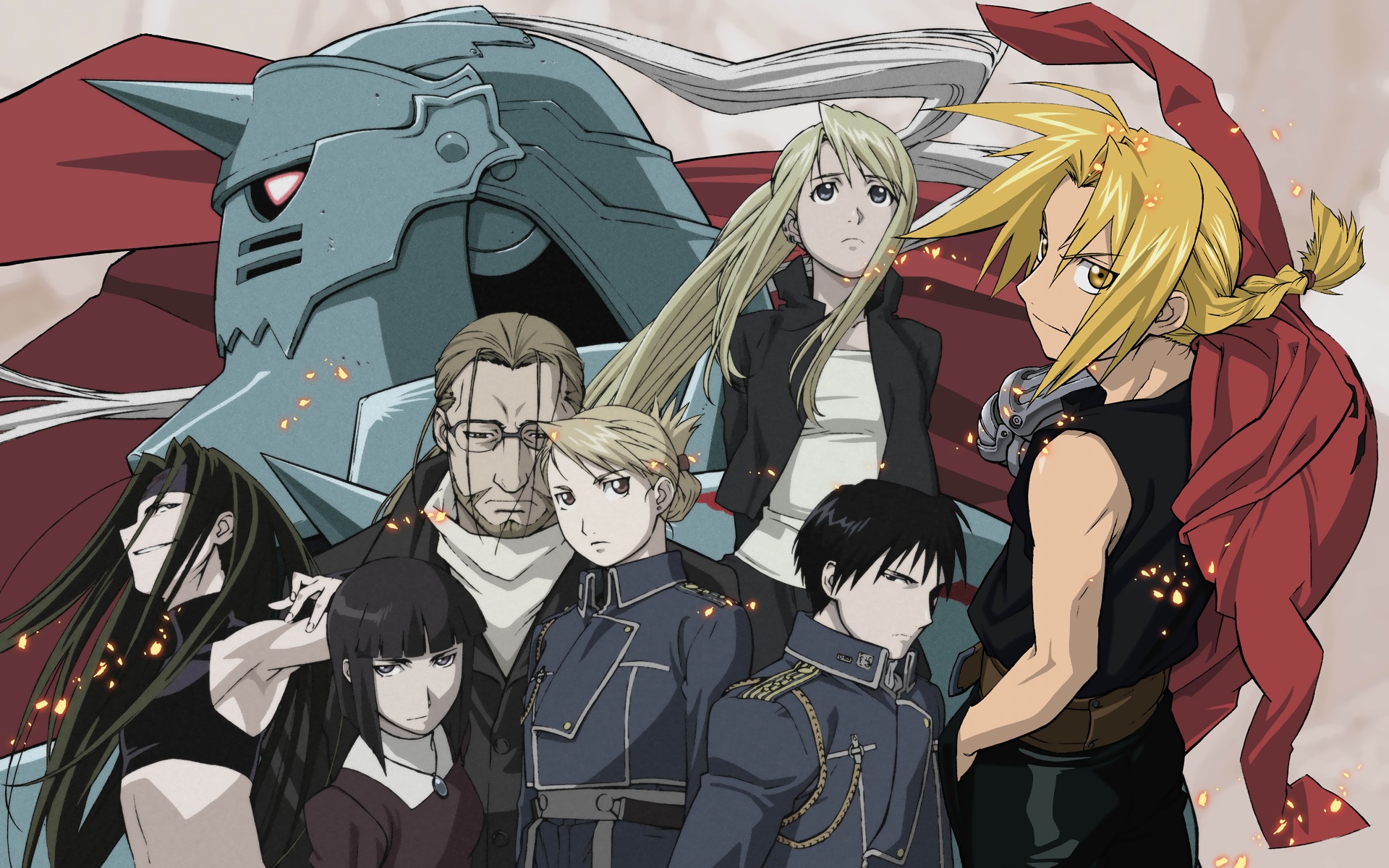
At Jugs's urging, I've finally gotten around to watching the 2009 version of the Fullmetal Alchemist anime, known in English as Fullmetal Alchemist: Brotherhood. I'm pretty sure no one will be surprised to hear that I found it to be far superior to the first crack at animating the series, from 2003. Though that's not to say I didn't enjoy that version; I loved it. Some of the episodes are actually paced better than their 2009 counterparts, the atmosphere is appropriately dark, and I thought it was incredibly clever what they did with the Homunculi (ie that they were – highlight for 2003 spoilers –  the results of attempted resurrections, e.g. Tricia became Sloth and Izumi Curtis's son became Pride). It's only that the new one surpasses even those lofty standards. But both are great, featuring a rich setting, an interesting story, and characters who are varying degrees of stylish, sympathetic, impressive, and fascinating.

Of course, the new version does benefit from contemporary technology. The fluid animation and colourful visuals make the action scenes engaging, whether the combatants are duelling with swords, guns, or alchemy, and, thanks to skillful camera work, we always have a good idea of their surroundings and positions relative to each other. The setting and certain story elements reminded me of Chrno Crusade, so I gave an episode of that a watch, and boooooy had I forgotten how bad the action was in that show. The typical formula there is to flash a close-up shot of a good guy firing their weapon, then cut to the bullets rebounding off the monster of the week. It's completely bland and devoid of tension. Gun battles in Hagaren do this sometimes too, but in Hagaren we always know where everybody is, people die frequently and in dramatic fashion, and attacks feel more destructive, making the proceedings seem dangerous and chaotic.

All of that action, however, is not to no purpose. The Matrix has a brilliant synergy between thought and action, and, standing amongst brainless thrillers, was the first work to show me that the Action genre could be smart, if it wanted to. Hagaren was quite possibly the second. Since I'm theoretically a Philosophy Major, I'm inclined to look at everything I see in terms of that academic background, much as a physicist will look at everything in terms of certain scientific principles, or a skateboarder will see the world in terms of obstacles and “spots.” This series provides plenty of philosophical material.

Don't get me wrong, Hagaren isn't nearly the most philosophically weighty series I've ever consumed, and you'll typically get laughed out of the thread if you bring it up in any “philosophical anime” discussion. But if you're interested in looking a little deeper at some of the stuff that's raised, here is a brief analysis of what I have identified as the three main themes. There are others, of course, like humanity, community, the cost of ambition, and the meaning of family, but I believe these three to be the most major.

Obviously, this post will contain spoilers.

Tertiary theme: Faith

If anything, Arakawa, or at least this work, seems to take a dim view of religion, especially Renaissance-era Christianity. The only major institution we see is the Cult of Leto, which the Elric Brothers quickly expose as a sham, a play by one power-hungry priest to gain deeper loyalty and deeper coffers. What's interesting to me is that this is one of the few cases where a fictional atheist actually has some intellectual elbow room. In this setting, as in the real world, the existence or non-existence of God is still very much up for debate. This is in stark contrast, to, say, Final Fantasy X, in which the necessity of sending recently departed souls to the afterlife via particular rites is an observable fact. Believing otherwise would be willful ignorance. This is what TV Tropes calls a “Flat Earth Atheist,” someone like Kaiba Seto, who stubbornly refuses to believe in magic despite regularly seeing it performed in front of him. But in the world of Hagaren, Ed's atheism is entirely justified.

What's stranger is what happens when Homunculus actually comes face-to-face with the being who claims to be God, ruler of the heavens and the earth, after hundreds of years of vying to gain His favour. Rather than praising his loyalty and ambition, the mighty spirit actually chastises him for blindly relying on a higher power, rather than looking towards himself for motivation and agency. The message here seems to be to pull yourself up by your own bootstraps, rather than holding out for a saviour. This is reflected in the main action of the story, as the brothers make all their major advances through hard work, intelligence, talent, smart timing, and, quite often, hours spent poring over dozens of books and documents. They do occasionally get a little help from their friends, but remember that they only gained those relationships from actively working to expand their network of contacts. And sometimes they hit a stroke of luck, but those only come about from consistently pursuing as many angles as possible, in the hopes that at least one of them will work out.

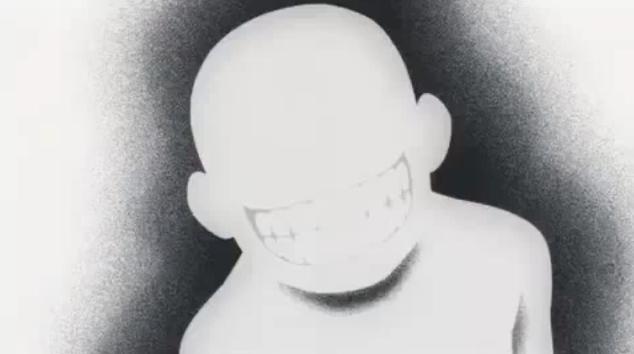
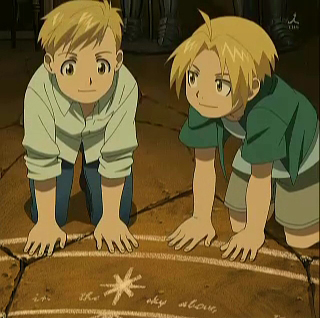
That said, I'm not completely sure what to make of “God,” the grinning white imp who sits in front of the Door of Truth and purveys knowledge but applies a personalized punishment for having wanted it. We have no real way of confirming whether this really is God or just some lesser spirit making claims of grandeur, or if God even exists in this universe, but let's take Him at his word and assume for a moment that He really is “the” God. In his own words: “I am what you call 'the World,' or 'God,' or 'the Truth,' or 'All,' or 'One.'” Those last two (全と一、zen to ichi) echo the arc in which Edward and Alphonse, as children studying under their teacher Izumi Curtis, come to understand the laws of the natural world, and thus alchemy. The entire universe, it turns out, is made up of an unbroken “flow,” so that all is one, which is why the circle is the basis of all transmutations; this is later confirmed by Mei Shan, who says that Xing's version of alchemy draws from a power source that they imagine as a river flowing to the tops of the mountains, through the air and back into the earth.

This “zen to ichi” concept closely resembles Tillich's conception of God. In his view, trying to imagine God as a being –  even if He is the greatest, most glorious of all beings in existence – is the wrong way of trying to understand Him. He is not a particular force, acting in a particular way, in a particular series of places, at a particular time (God is timeless, not in the sense of temporal infinity but in that He is outside of time entirely). Rather, God is everywhere, manifested in everything, constantly, because He is not particular but universal. Conceiving of him as merely our unknowable Father in Heaven is akin to putting a hard barrier between you two, which makes no sense as he is “closer to you than you are to yourself.” He is not a “being among beings” but the “Ground of All Beings.” You see this way of thinking every time somebody equates God with “the Universe” or a similar concept.

Sin is another topic that comes up periodically, and one which is, naturally, rather religious in nature, as without a higher arbiter of some sort or another there can be immorality (arguably), but not sin as such. The main sin we see humans committing is hubris, saliently in thinking that they can defy the laws of nature and create life. Edward explicitly refers to their resurrection attempt as a “sin” several times. In return for trying to gain this knowledge, alchemists have something taken from them, which can only be reclaimed if they manage to find something else to pay for it; Hohenheim tells Izumi he cannot restore her lost organs specifically because her having lost them was a mark of her punishment from God. We eventually learn that He takes whatever seems the most suitable for their arrogance: Edward, with his unswerving principles, lost the ability to stand upright; Izumi, who wanted her dead son back, lost the ability to ever have another; Roy Mustang, with his eyes on the Fuhrer's chair and the future of Amestris, lost his sight. (Notably, while Edward does recover his fleshy arm, which he paid in order to affix Alphonse's soul to a suit of armour, he never does get back his leg, which was the original toll incurred for attempting the resurrection.) Everyone who makes this mistake seems to take the lesson to heart, warning others against following the same path, and Edward even says that he and Alphonse will never again try to resurrect their mother, and are only on a quest to regain what they lost in the attempt.

This would seem to suggest that of all the Seven Deadly Sins, Pride is the “worst.” Indeed, this is not only the first sin that Homunculus dispels from his body, but also the one that most closely resembles his own true form, as one character points out to us. But Hohenheim makes an interesting point when he says that these seven destructive desires (Pride, Envy, Greed, Lust, Gluttony, Sloth, and Wrath) are an integral part of what makes us human, or as he puts it, “essential to understanding humans,” which is basically the same thing.

Totally unrelated note, this reminds me of the movie Serenity (the conclusion to the TV show Firefly), where there's an assassin going around murdering people, as assassins are wont to do, I guess, and he must be a Godfearing kind of a guy because right before he murders someone, he always asks them, “Do you know what your sin is?” and then, since it would be a bit of a dick move to ask a question like that and then leave them hanging, he tells them. Except when he asks Mal, Mal says “Ah, hell, I'm a fan of all seven. But right now...I'm gonna have to go with Wrath,” and kicks his ass.

What's your sin? I'm, yeah, pretty sure mine is Lust.

Secondary theme: Equivalent exchange

I think Alphonse summed up the concept beautifully in the OP of the 2003 version of the anime. I can still recite it from memory four years after watching:

人は何も犠牲無しに何も得る事は出来ない。
何かを得る為には、同等の代価が必要になる。
これが錬金術における「等価交換」の原則だ。
その頃僕らは、それが世界の真実だと信じていた。

Humankind cannot gain anything without first giving something in return.
To obtain, something of equal value must be lost.
This is alchemy's first law, of “equivalent exchange.”
In those days, we really believed this to be the world's one, and only, truth.

Amazing. I heard those words on YTV late one night and I was hooked. Those four lines tell us everything we need to know about the show's direction and what we're about to watch. That goes double for the 2003 version, which downplays the next theme I'm going to discuss in favour of this one.

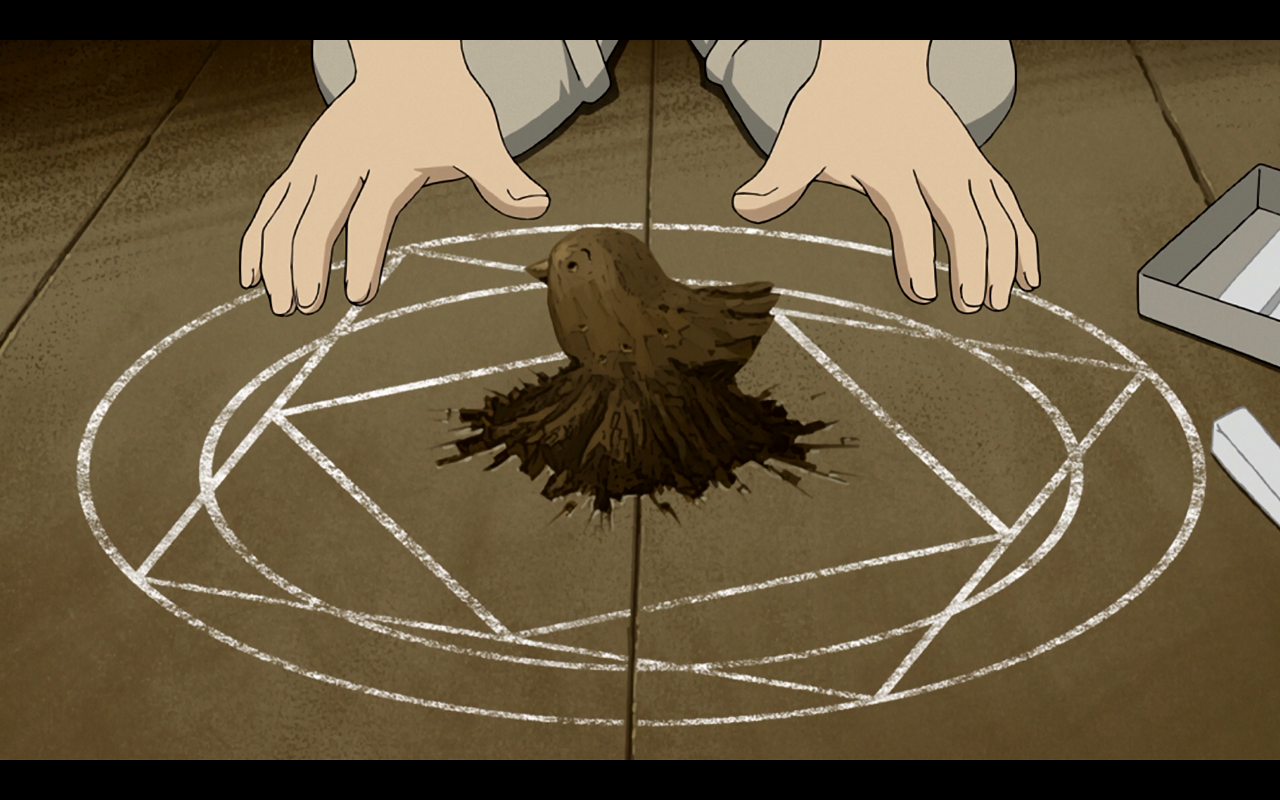
This principle, of course, is clearly meted out through the events of Hagaren. Alchemists cannot create things, they can only transform. Edward is able to make Lin a sword from a giant pool of blood by drawing together a bunch of iron. When he repairs Alphonse's armour, the metal becomes a little bit thinner each time. The very reason Kimblee is so dangerous and feared is that he can create a bomb from whatever substances he has around. When alchemists transmute part of the ground or a wall, a depression appears in the surface near whatever they shaped, showing that the matter was drawn into it. And the primary drama of the 2003 series is trying to figure out the nature of a human soul (the answer is much clearer in the new one), since the necessary materials to manufacture a human body can be purchased “on a child's allowance,” but even with all of them present and in their proper amounts, something is still missing.

One more example to hammer this home. In an early episode, glossed over in the 2009 version, the brothers travel to Youswell, a coal-mining town, as inspectors. Like as mystery shoppers, or the entire plot of that one stage play. The townspeople are distrustful of Edward as a “Dog of the Military,” despite the fact that State Alchemists are sworn to serve the public trust, protect the innocent, and uphold the law. The brothers quickly discover that the military guy running the town, Yoki, is a far harsher regent than HQ imagines. Edward convinces Yoki to sell him the town for a massive sum of gold, but since transmuting gold is a felony, they agree to officially have him sign the deed over for nothing. Yoki is well pleased but the next morning realises he's been had, as the gold has returned to its original worthless state. He demands that Edward pay him, only to be reminded that he gave the town away for free.

Edward then mischievously waves the deed in front of the townspeople, telling them that he's going to extract a heavy fee for their freedom. His price? A night's room and board at the local inn, that is, practically nothing. Everyone is stunned but quickly moved to rejoicing at his heroism. Ed might as well have handed the deed directly over to them for free, considering what he charged for it, but he states that by not doing so, he is satisfying the law of equivalent exchange. Perhaps he believes that had he not at least asked for something, a price would have ended up being extracted by some other subtle means, and been far higher. Either way, this is an early demonstration of how important the concept of touka koukan is going to be.

And if you think about it, it makes sense. Alchemy doesn't exist in our world, but equivalent exchange certainly does. If you, like me, are weak in scientific knowledge, do you at least remember doing scientific equations in high school? You started with a set of chemicals, charted its reaction with another set of chemicals, and ended up with something new. Here:

Here's the thing, though. No matter what, you have to end up with all the same stuff you started with. They'll probably be in a different form, maybe with an -ide or an -ate on the end of their names now, but they'll all still be there, and in the same numbers. That's equivalent exchange. Hell, we have this in physics, too. You drop a basketball on the ground, it'll start to bounce lower and lower because it's losing kinetic energy to heat. If you pick it up again and hold it perfectly still, it hasn't lost its energy; it's just that now it's potential energy instead of some other kind. Energy can never be created or destroyed, it can only change form. Same with matter. For every action, there is an equal and opposite reaction.

This even gets back to Part 1 of this analysis, as we see this concept in many world religions as well. If I understand it correctly, you could apply karma to the idea of touka koukan, as karma works off the “garbage in, garbage out” system. And the Biblical “eye for an eye” does seem to call for an equivalent exchange of sorts, if not quite in the way that Hagaren means it, as it suggests that destruction requires equivalent destruction in punishment, whereas Hagaren is saying that creating something requires the destruction of something else.

If that were where it ended, though, it would be an interesting curiosity but not philosophically valuable. But you can apply touka koukan to everything. If I want to buy a sandwich, I have to have the money to exchange for it. To get my hands on that money, I have to possess relevant skills that I am willing to hire out. To improve my Japanese, I must sacrifice a certain number of hours studying. If you want bigger muscles, a prettier face, or better grades, you “have to be willing to put the work in,” as, don't you worry, no shortage of people will leap to remind you. For that matter, if you even want to go three blocks down the road you have to make a choice between either spending a little extra time by walking, or paying in pollution, fuel (which itself is an exchange of fluid for locomotion), and the gradual degradation of rubber from the friction that pulls you forward against the road. Coins for Charon. Soul Shells to get to Battleship Island. If you want through the gate, you have to pay the toll. A day's work for a day's pay.


Of course I'm sure you can come back at me with all kinds of examples of people having things taken from them unjustly, or working endlessly for no discernible gain. And we all know somebody who everybody else hates because they've never had to work for anything (if you don't, it's you) and don't even realise it. In a way, though, doesn't that actually prove that the principle of touka koukan exists? If people get upset when it seems to be violated? And when things seem to cost more than they're worth, or someone receives disproportionate retribution? The world is harsh and unfair, and people regularly lose everything to random accident, but we feel that equivalent exchange should still govern our dealings with each other, if nothing else.

In the next post, I'll explain what I feel to be the most important theme of all.

Tuesday, 29 October 2013

I have the package

Shortly before I temporarily left Japan, I shipped a big box of stuff to Canada. The postman came right to the dorm for his regular deliveries, helped me fill out the form, and departed with my stuff crooked under his arm. Five years ago, at the conclusion of my high school exchange, I sent a couple of packages as well...but it was a very emotional time, and I couldn't bring myself to open them at first, because I felt like in some way it would officially signal the end to a time I'd treasured. And then days turned into months and then it was just kind of a thing.

Today I opened all three. I barely remembered what I put in the one I shipped two months ago, never mind five years.

 Ok then, U-Pack. What have you got for me?
 Pokemon, the jinbei from English Club, some books, more Pokemon. All right, sure.
 Ah! FF for Jugs, Tales for Goku. Picked these up at Kyouto Animate. They were well-received.
 Here I have tried to arrange my Pokemon charms into the shape of Japan, their positioning corresponding to the region they represent. As you can see, I failed.

Enough of that. Time to jump into nostalgia in the worst way.
 It looks like I stuffed as many papers as possible anywhere they would fit. Right on top are the slightly crumpled lyrics to a song my class did for a contest. In Japanese high schools, you stick with your homeroom class, and the teachers come to you. Obviously this means that a Japanese high school student has nowhere near the course choice or autonomy of a Western one, but the main advantage is that the class becomes a family, and I really mean that. My class was the best part of my previous stay. It was full of wonderful, energetic, kind people who were not only quick to welcome me into the fold, but continually proved their willingness to help me survive in the school and not only endure but actively help cultivate my tottering and unsure Japanese.

Homeroom classes do a lot of activities together, one of which was a...I don't know what you'd call it. A singing contest, is what it was anyway. The more proactive students selected a few songs, we narrowed it down to two, thought up a little skit, and then competed with the other classes in our year. I gather it was a nationwide competition so the winners must have advanced to the intramurals and so on. We didn't win, but practising with everybody is one of my fondest memories from that time. This video from 1rittoru no Namida should give you an idea what it was like. As you can see we performed a half-English, half-Japanese rendition of “A Whole New World” from Disney's Aladdin. I can still recite parts of the Japanese lyrics from memory. My class also did “Oh Happy Day” but I wasn't part of that group. Remember that one pretty well too, though.
 On the first day we were required to do a test. Looking back I have no idea what the point of that was, since everybody there had already written an entrance examination, but I guess it was just to assess our abilities. Of course I was hopelessly lost, and though my teacher said I should ask if I wasn't sure what to do, I didn't want to take up time that would be better spent on my classmates, who, unlike me, were actually expected to perform somewhat acceptably.

Of course I was able to do the English section with no problems, even without being able to read the instructions, but the rest was impossible. I barely attempted the Kokugo. I was later placed in a Math class since that's pretty much the same in every language, but not only is Canadian Mathematical pedagogy woefully inadequate, I was pretty damn horrible at even that.
Hey, somebody check this and tell me if my math's correct. It probably isn't. On another page I adorably wrote “FOIL” in the margin, as if it was too abstract and complex an idea to hold in my head without having it in front of me.
 A, uh, pamphlet that's been scrawled all over with marker and shot to hell with a hole-punch. I can no longer recall its origin but it clearly must have meant a great deal to me at the time. Jesus but I'm a sentimental bastard, aren't I?
 I didn't spend every class with my class, as it happens. Some of them, like Kokugo, would have been too far beyond me, and the school's administrators thought (as did I) that it would be beneficial to experience a wide range of topics and classroom settings. So, for four blocks a week, I would trek over to some other class and sit down with them. One was Sekaishi, with a class that I always felt I would have loved to have been a part of every bit as much as I did my own, if it had shaken out that way. Hero of another story and all that. This paper was clearly from my Nihonshi class, where I first learned the word “bakufu.” There were a couple of girls in that class who sat near me that I always enjoyed talking to. They were hot.
 Whoooooakay then. No, I wasn't foisting my nationalist pride on everyone around me. These were supposed to be gifts. Obviously I didn't end up distributing them all, but they're good to have.
 Hey, I remember buying this! Seems I had halfway decent taste in high school. Still in ok condition, too. Never did know who DJ Honda was, though.
 ...yeah ok.
 Oh, right. I used to be kind of a nerd.
 Ah, Hagaren! Book-Off has always been good to me.
 They don't quite jive with the rest of the collection, though.
 An...empty plastic bag. Seriously, what the fuck was wrong with me?
 Aha! Cardcaptor Sakura was what I was using for reading practise back in the day, and it was every bit as difficult for me then as 1Q84 is now. However, I never quite completed my collection. Each volume, you see, was originally packaged with a bookmark in the form of a Clow Card. My ambition was to obtain a complete set of Clow Cards, so I always vowed to gather the rest whenever I returned to Japan. Unfortunately, since I refused to open up the box and check I had no idea which ones I was still missing, so I couldn't do it this time. Guess that just means I have to get back as quickly as possible.
 Actually, as you can see I was tantalizingly close to getting them all. Damn!
 A T-shirt, which I bought in 2008, that celebrates the Rolling Stones tour of 1981-82, which I was unable to attend because I was too busy not having been born yet.
Aaaaand here's all the Gundams I acquired over the course of a semester (along with two other still unbuilt ones that I bought in Canada). I seem to have packed them first and then jammed everything else in around them. In total, it looks like I bought twelve. I'd often arrange and rearrange them on my bed or a table, simply admiring them, glowing with pride every time another machine or two joined their ranks. Yes that's both a regular and Char Custom Zaku, and yes that's two versions of Freedom. Shut up.

I find it really rather unbelievable that I ever thought that this was a good use of money, or that I'd be able to find space in my room for them, or, most of all, that I'd ever, ever have the time to build all these fucking things. Amazing how priorities change.

There is one thing I didn't find amongst this clusterfuck. Over those five months, I kept an incredibly dense journal, filled with reams of completely unnecessary detail, that I'd hoped might turn up. The fact that it did not means that I felt it was precious enough to carry it with me in my backpack, and that it is most likely now lodged deep in some other box, in the bowels of my parents' basement, possibly on another plane of reality. If I ever come across it again, or just get the itch to reminisce, I'll share some of the stories from that period – and there are some good ones. For now, I hope you've enjoyed the snippets. Looking through this stuff has given me some perspective on my most recent ryuugaku, as in a lot of ways, they were really very similar: Joyous, painful, thrilling, and ultimately transformative. That is, everything a ryuugaku should be.

Saturday, 16 March 2013

Toukyou wrap-up


To get to Pokemon Centre Yokohama, go out the west exit of Minato-Mirai Eki, turn left, and then head left again on Sakuragichou. Eventually you'll come to a pretentious statue.


To your right is Landmark Tower, and your target is inside. I have to say that Pokemon Centres, as a concept, are somewhat losing their impact with each successive visit, since they're kind of samey. Doesn't detract from the sweetness of acquiring my Yokohama Original charm, though. Too bad I can't sell Soymilk on a daytrip to Sendai. I fantasize about working at the Oosaka location. That would be awesome.

Know what else? They've got Showers dolls, so my Eeveelution set is complete. Soymilk grabs a few for himself, because apparently profiteering is a lucrative industry among Pokemon-loving expats, who speculate on limited-sale dolls that are likely to become hot items in a few months and then sell them on eBay at a 1000% markup. Have I mentioned that Soymilk is morally against both advertising and having to pay money for entertainment?

One floor up, there's a store that sells nothing but merchandise from Shounen Jump serials. Eh, meh.

Rude Boy: This would have been the coolest thing ever if I'd come here in high school.
Soymilk: Me too.
Rude Boy: Oh my god, is this what it's like getting older?
Soymilk: Yes. It's terrible.

Soymilk only agreed to my Pokemon errand on the condition that we at least check out the Yokohama DDR scene, and we're quite pleased to find that the group is made up of some pretty rad people. The culture here is pretty different from what we're used to. Japan has a higher density of players, a dickload more tournaments, and skews towards timing whereas the West has a stamina bias. Plus, when you want to play, you have to write your name down on a sign-up sheet.

Rude Boy: Hey, never seen it done like this before. In my arcade in Canada people just kind of do whatever.
Yokohama player: Yeah, we do things differently in Japan.
Rude Boy: Well, I think it's because it's a much smaller arcade.
Yokohama player: Japanese people need rules. If we don't have this, nobody will know who gets to play next.
Rude Boy: Are y...yeah, sure. That's gotta be it.

Also, there's two girls there, and they're both genuinely hot. Any idea how rare that actually is? Like, really rare. I mean, I know that all readers of this blog are stunningly attractive and intelligent, but outside of you guys, there's a dearth of hot rhythm-gaming girls. I'm just saying.

So, uh, we really didn't end up seeing too much of Yokohama. Um. The area around the station seemed nice.

Does it seem like we started strong on the sightseeing and then lost steam? That's not quite it. We still did stuff, it's just that most of it wasn't especially bloggable. For example, there's a ton of stuff I wouldn't mind getting to on my final day in Toukyou, but Soymilk vetoes all my ideas and takes me clothes shopping instead. God only knows why, but he's determined to transform me into some kind of fashionable ladykiller. I think it's a little side-project he's taken up. Not that I can complain, since he's got a damn good eye for this stuff, but it does mean that we're left with a very narrow window before I need to be getting on my way.

Soymilk: So basically you have your choice between Shinjuku and Ikebukuro. Neither one is better.

Right outside the station is Ikebukuro Nishiguchi Kouen, which features prominently in the drama “Ikebukuro Nishiguchi Kouen.” I'm disappointed to see a distinct lack of yankii, but maybe times have changed. Might be for the best, considering the stupidity I got caught up in last time I shot a group of yankii.


That said, I do see slews of uniformed schoolgirls huddling in groups of ten and fifteen, with nary a guy in sight. If the back alleys were arteries, these girls would have given Ikebukuro an aneurism long ago. I contemplate taking a picture of some of them in light of the yankiiless park, but decide that would probably get me in real trouble.

My very last Toukyou sight is Animate, or “Akihabara for Girls,” as it is apparently sometimes called. Which pretty much sums it up. Ever the niche fan, Soymilk makes a beeline for the doujins.

Soymilk: We're the only two guys on this entire floor. (beat) Yeah let's leave.

The highway bus company I'm riding back with has a number of classifications for their buses, and I'm a little concerned that I'll be riding Standard on the way back, given the experience I had with the level above it, which was called Relax. If you have to upgrade just to be able to relax, I can't even imagine what the hell kind of emotions the Standard ride is supposed to invoke. By the way, if you go yet one more level above Relax, only then do we finally arrive at “Comfort,” which speaks volumes.

Back in Kyouto, I feel like I've returned to my domain. My time away has only made me appreciate it more. Toukyou was great, but after all, Kansai is home.